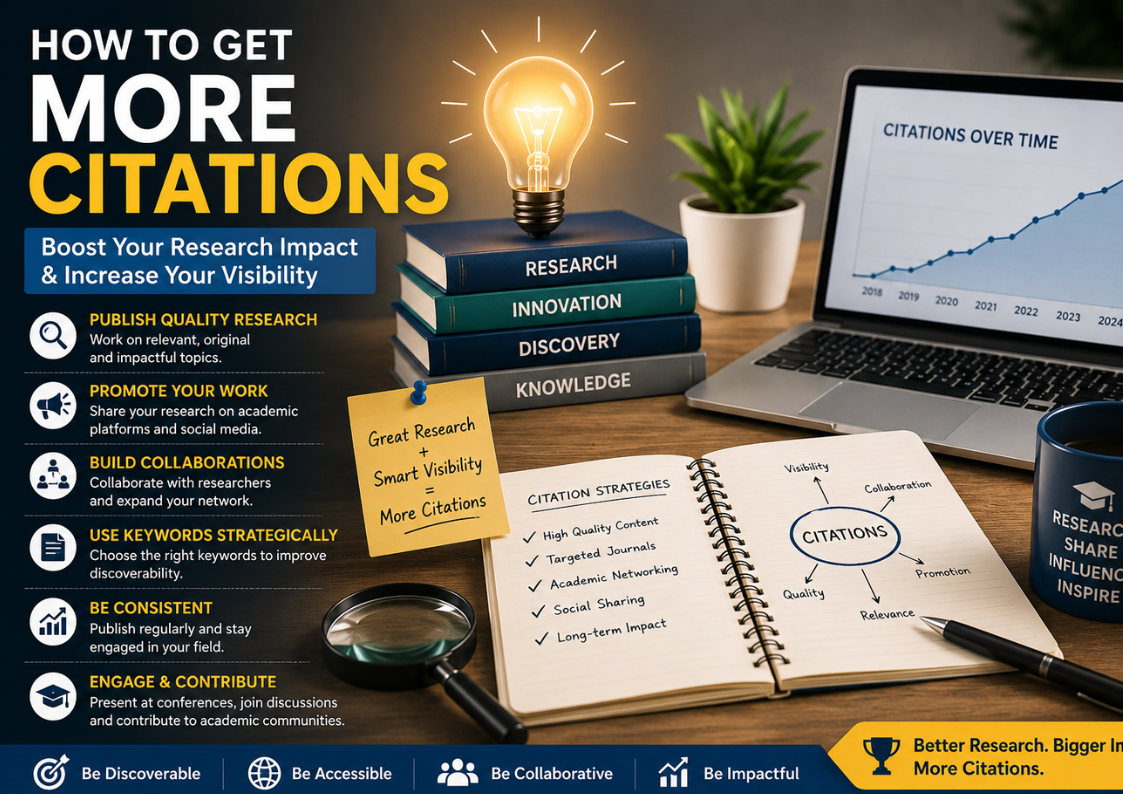
Publishing a research paper is a significant achievement, but publication is only the beginning of your research journey. Once your work is published, the next challenge is ensuring that other researchers discover, read, and cite it. For many academics, receiving citations is an important measure of the influence and reach of their work.
Citations are more than just numbers. They demonstrate that your research has contributed to ongoing scholarly conversations and has helped others advance knowledge in your field. Universities, funding agencies, promotion committees, and ranking organizations often consider citation metrics when evaluating researchers and institutions.
However, earning citations does not happen automatically. Many high-quality papers remain unnoticed simply because they are not visible to the right audience. On the other hand, well-promoted and accessible research often gains recognition much faster.
This guide explains practical, ethical, and sustainable strategies to help you increase citations while maintaining academic integrity. Whether you are a graduate student, early-career researcher, or experienced faculty member, these approaches can help your research reach a wider audience.
Why Do Citations Matter?
A citation indicates that another researcher has used your work to support, compare, or expand upon their own research. Every citation reflects academic recognition.
Higher citation counts can contribute to:
- Stronger academic reputation
- Better career opportunities
- Increased chances of research funding
- Improved university rankings
- Higher visibility within your discipline
- Better prospects for academic promotion
- Stronger research collaborations
- Growth of your H-index and other impact metrics
Although citation counts should never be the sole measure of research quality, they remain one of the most widely recognized indicators of scholarly influence.
What Makes a Paper Highly Cited?
Many researchers believe that publishing in a prestigious journal automatically guarantees citations. While journal reputation can help, it is only one of several contributing factors.
Highly cited papers typically share several characteristics:
- They address meaningful research questions.
- They solve practical or theoretical problems.
- They present original findings.
- They are easy to understand.
- They are published in visible and credible journals.
- They remain relevant over time.
- They are actively shared within the research community.
A combination of quality research and effective dissemination usually leads to higher citation potential.
1. Choose a Research Topic That Matters
One of the biggest determinants of future citations is your research topic.
Before beginning a project, ask yourself:
- Is this problem currently important?
- Are researchers actively publishing in this area?
- Does the topic have long-term relevance?
- Can my findings help future studies?
Research that addresses emerging technologies, public health, sustainability, artificial intelligence, climate change, education, cybersecurity, renewable energy, and similar rapidly evolving fields often attracts considerable attention.
Selecting a relevant topic does not guarantee citations, but it significantly improves your chances.
2. Publish in Reputable Journals
Journal quality plays an important role in research visibility.
Established peer-reviewed journals generally have:
- Wider readership
- Better indexing
- Higher credibility
- Strong editorial standards
- Greater discoverability
Publishing in journals indexed by recognized databases increases the likelihood that researchers searching for literature will encounter your work.
Avoid submitting your research to predatory or questionable journals. While they may promise quick publication, they rarely provide meaningful visibility or academic recognition.
3. Write a Clear and Search-Friendly Title
Your paper's title is often the first thing readers see.
A good title should:
- Clearly describe the research
- Include important keywords
- Avoid unnecessary abbreviations
- Be concise and informative
Compare these examples:
Weak title:
"Some Studies on Learning"
Improved title:
"Artificial Intelligence-Based Personalized Learning Systems in Higher Education: A Systematic Review"
A descriptive title improves search engine visibility and helps researchers identify relevant papers more quickly.
4. Optimize Your Abstract
The abstract is one of the most frequently read sections of any research paper.
An effective abstract should summarize:
- Research problem
- Objectives
- Methodology
- Major findings
- Practical significance
Include naturally relevant keywords without excessive repetition.
Many researchers decide whether to read the full paper based solely on the abstract.
5. Select Strong Keywords
Keywords help indexing systems categorize your research.
Choose keywords that:
- Reflect your research accurately
- Match commonly searched academic terms
- Include both broad and specific concepts
Avoid choosing overly general or unrelated keywords simply to attract attention.
Well-selected keywords improve discoverability in academic databases.
6. Produce High-Quality Research
No promotion strategy can compensate for weak research.
Researchers cite papers because they provide:
- Reliable evidence
- Innovative methods
- Useful datasets
- Strong theoretical contributions
- Practical applications
Focus first on producing research that genuinely advances knowledge.
Quality remains the foundation of lasting citation impact.
7. Build a Google Scholar Profile
Creating a Google Scholar profile allows your publications to become more visible.
A complete profile should include:
- Current affiliation
- Research interests
- Professional photograph (optional)
- Verified institutional email
- Updated publication list
Google Scholar also tracks citation counts automatically, helping you monitor your research impact over time.
8. Maintain an ORCID Profile
An ORCID identifier provides a permanent digital identity for researchers.
It helps:
- Distinguish your work from researchers with similar names
- Connect publications across platforms
- Improve discoverability
- Simplify manuscript submission
Many journals now encourage or require ORCID registration.
9. Share Your Research Responsibly
Publishing alone is not enough.
Researchers should actively share their work through professional channels.
Examples include:
- University repositories
- Personal academic websites
- Department webpages
- Academic networking platforms
- Institutional newsletters
Always respect publisher copyright policies when sharing published articles.
10. Present Your Work at Conferences
Conference presentations increase exposure before and after publication.
Presenting your research allows you to:
- Receive feedback
- Meet collaborators
- Introduce your work to specialists
- Build professional relationships
Researchers who attend conferences often gain valuable visibility that later contributes to citations.
11. Collaborate with Researchers
Collaborative research often reaches wider audiences.
Working with researchers from different institutions or countries can increase:
- Knowledge exchange
- Research quality
- International visibility
- Citation opportunities
Interdisciplinary collaborations are becoming increasingly valuable because they connect multiple research communities.
12. Make Your Paper Easy to Read
Complex language does not necessarily indicate better scholarship.
Well-cited papers are often:
- Clearly organized
- Logically structured
- Free from unnecessary jargon
- Easy to follow
Readers are more likely to cite work they fully understand.
Clear communication enhances both accessibility and academic impact.
13. Cite Relevant Literature Responsibly
Strong literature reviews strengthen your paper.
They also help position your work within existing research.
However:
- Cite only genuinely relevant studies.
- Avoid excessive self-citation.
- Never exchange citations solely to inflate metrics.
Ethical citation practices maintain research credibility.
14. Publish Consistently
Researchers with consistent publication records often receive more citations over time.
Regular publishing helps:
- Expand your academic profile
- Build expertise within a research area
- Increase cumulative visibility
Rather than rushing multiple papers in a short period, focus on producing high-quality work consistently.
15. Build Your Academic Network
Networking remains an important aspect of academic life.
Meaningful professional relationships can lead to:
- Collaborative publications
- Invitations to research projects
- Conference opportunities
- Greater awareness of your work
Networking should focus on knowledge sharing rather than citation requests.
16. Use Institutional Repositories
Many universities maintain digital repositories that archive research publications.
Depositing eligible versions of your work can:
- Increase accessibility
- Improve search engine indexing
- Expand readership
- Generate additional citations over time
Institutional repositories often appear prominently in search results.
17. Keep Your Research Profiles Updated
Many researchers create academic profiles but rarely maintain them.
Update your profiles whenever you:
- Publish a paper
- Present at a conference
- Receive an award
- Complete a project
- Change institutions
An updated profile reflects active research engagement and improves discoverability.
18. Focus on Long-Term Research Impact
Citation growth is usually gradual.
Most papers receive citations over several years rather than immediately after publication.
Researchers should remain patient and continue producing meaningful work.
Long-term consistency often leads to stronger citation records than short-term promotional efforts.
Common Myths About Citations
Many misconceptions surround citation counts.
Myth 1: More papers always mean more citations.
Not necessarily. One influential paper may receive hundreds of citations, while several weaker papers receive very few.
Myth 2: Publishing in expensive journals guarantees citations.
Publication fees do not determine academic impact.
Myth 3: Self-citation quickly improves reputation.
Limited self-citation is acceptable when appropriate, but excessive self-citation can negatively affect credibility.
Myth 4: Social media alone generates citations.
Social media may improve visibility, but citations ultimately depend on research quality and relevance.
Ethical Ways to Increase Citations
Always prioritize integrity.
Ethical practices include:
- Producing original research
- Publishing in reputable journals
- Sharing research responsibly
- Collaborating with researchers
- Using accurate keywords
- Maintaining academic profiles
- Participating in conferences
- Writing clearly
- Updating institutional repositories
Avoid unethical practices such as:
- Citation manipulation
- Citation cartels
- Excessive self-citation
- Artificial citation exchanges
- Publishing in predatory journals
Academic reputation is built over years and should never be compromised for short-term metrics.
Measuring Citation Impact
Several indicators help researchers evaluate the influence of their work.
Common metrics include:
- Total citation count
- H-index
- i10-index
- Average citations per paper
- Field-weighted citation impact
While these metrics provide useful insights, they should always be interpreted alongside research quality and disciplinary differences.
Final Thoughts
Getting more citations is not about finding shortcuts or manipulating metrics—it is about ensuring that valuable research reaches the people who can benefit from it. Strong citations are earned through meaningful scholarship, careful planning, clear communication, and consistent academic engagement.
Instead of focusing solely on increasing numbers, aim to produce research that addresses important questions, contributes original knowledge, and offers practical or theoretical value. Combine this with responsible dissemination, professional networking, and well-maintained academic profiles, and your work will naturally become more discoverable over time.
Remember that every influential researcher started with their first publication. Citation growth is often gradual, but with patience, persistence, and a commitment to research excellence, your scholarly impact can continue to grow throughout your academic career.
Ultimately, the most cited papers are not simply the most visible—they are the ones that genuinely help other researchers advance knowledge. Focus on creating work worth citing, and the citations will follow naturally.


No comments yet. Be the first!