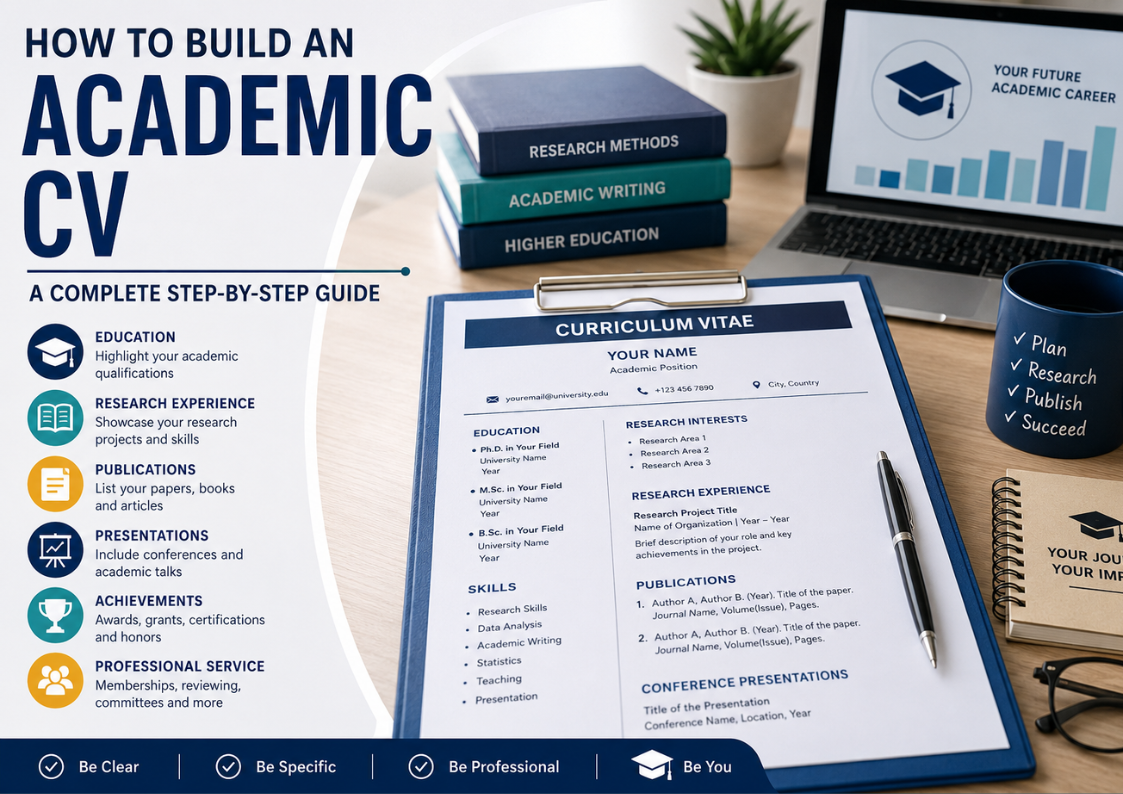
An academic CV is much more than a document that lists your education and work experience. It is a detailed record of your academic journey, research contributions, teaching experience, publications, presentations, awards, and professional achievements. Whether you are applying for a PhD program, a research position, a faculty role, a postdoctoral fellowship, or an academic promotion, your CV often becomes the first impression you make on a selection committee.
Unlike a traditional resume, which is usually limited to one or two pages, an academic CV can grow throughout your career. It evolves as you publish research papers, attend conferences, supervise students, receive grants, and contribute to your academic field.
Many talented researchers fail to secure opportunities not because they lack qualifications, but because their academic CV does not effectively present their achievements. A well-organized CV allows reviewers to quickly understand your expertise and evaluate your academic potential.
This comprehensive guide explains how to build an academic CV from scratch, what information to include, how to organize each section, and the common mistakes you should avoid.
What Is an Academic CV?
An academic Curriculum Vitae (CV) is a detailed document that presents your educational background, research activities, teaching experience, scholarly publications, professional accomplishments, and academic service.
It differs significantly from a corporate resume. While resumes focus primarily on professional skills and employment history, academic CVs emphasize research productivity, academic achievements, and scholarly contributions.
Universities, research institutes, funding organizations, and academic employers rely heavily on academic CVs to assess candidates. Because academic careers are built on continuous learning and research, the CV is expected to reflect both depth and progression.
Why Is an Academic CV Important?
Your academic CV serves several purposes throughout your career.
It helps you apply for:
- PhD admissions
- Postdoctoral positions
- Research fellowships
- Faculty appointments
- Academic promotions
- Research grants
- Conference speaker invitations
- Editorial board positions
- Visiting scholar opportunities
- Awards and recognitions
In many cases, your CV determines whether you progress to the next stage of the selection process. Therefore, investing time in building a strong academic CV is essential.
Academic CV vs Resume
Many students mistakenly believe these documents are identical.
Here are the key differences.
| Academic CV | Resume |
|---|---|
| Detailed document | Short summary |
| No strict page limit | Usually 1–2 pages |
| Includes publications | Rarely includes publications |
| Research focused | Industry focused |
| Teaching experience included | Optional |
| Conference presentations included | Usually omitted |
| Academic achievements emphasized | Professional achievements emphasized |
If you are applying for universities or research organizations, an academic CV is usually the preferred document.
Step 1: Start with Your Personal Information
The first section should provide basic identification details.
Include:
- Full name
- Professional email address
- Phone number
- City and country
- LinkedIn profile (optional)
- ORCID ID (if available)
- Google Scholar profile
- ResearchGate profile
- Personal academic website (if available)
Avoid including unnecessary personal details such as:
- Religion
- Marital status
- National identification numbers
- Passport information
- Political views
- Family information
These details are generally not required unless specifically requested.
Step 2: Write a Strong Academic Profile
A professional summary helps readers quickly understand your background.
This section should briefly explain:
- Your academic discipline
- Research interests
- Current position
- Areas of specialization
- Career goals
Example:
"I am a researcher specializing in environmental sustainability and climate policy with experience in interdisciplinary research, academic writing, and university teaching. My research focuses on sustainable development, environmental governance, and policy implementation."
Keep this section concise but meaningful.
Step 3: List Your Educational Qualifications
Education is one of the most important sections.
Arrange your qualifications in reverse chronological order.
Include:
- Degree name
- University
- Country
- Graduation year
- Dissertation or thesis title (optional)
- Supervisor name (optional)
Example:
Doctor of Philosophy (PhD)
University Name
2025
Dissertation:
"Artificial Intelligence Applications in Healthcare Decision-Making."
Step 4: Include Your Research Interests
Research interests help employers understand your specialization.
Instead of writing broad subjects, be specific.
Weak examples:
- Science
- Education
- Technology
Better examples:
- Machine Learning
- Climate Change Adaptation
- Consumer Behavior
- Digital Marketing
- Renewable Energy
- Public Health Policy
Usually, 5–10 research interests are sufficient.
Step 5: Add Teaching Experience
Teaching experience demonstrates your ability to contribute beyond research.
Include:
- Position
- Institution
- Duration
- Courses taught
- Responsibilities
Example responsibilities:
- Delivered undergraduate lectures
- Designed course materials
- Conducted laboratory sessions
- Evaluated assignments
- Mentored student research
Even teaching assistantships should be included.
Step 6: Present Your Research Experience
This section highlights your scholarly work.
Include:
- Research projects
- Laboratory experience
- Field studies
- Research assistantships
- Funded projects
- Collaborative research
Mention:
- Project title
- Institution
- Duration
- Your role
- Research outcomes
This section is particularly valuable for early-career researchers who may have limited publications.
Step 7: Organize Your Publications Properly
For many academic employers, publications receive significant attention.
Divide them into categories such as:
Journal Articles
List published papers using a consistent citation style.
Books
Include:
- Title
- Publisher
- Publication year
Book Chapters
Separate them from journal articles.
Conference Proceedings
Include peer-reviewed conference papers separately.
Never mix accepted papers with published papers.
If necessary, create a section titled:

No comments yet. Be the first!