For many academics, earning a position as an Assistant Professor is only the beginning of a long and rewarding journey in higher education. The next major milestone is promotion to Associate Professor—a recognition that reflects professional growth, scholarly achievement, teaching excellence, and meaningful contributions to the academic community.
One of the most frequently asked questions among faculty members is: What are the requirements for promotion from Assistant Professor to Associate Professor?
The answer depends on the university, country, discipline, and institutional policies. However, most higher education institutions evaluate candidates based on a combination of teaching performance, research productivity, publications, professional service, leadership contributions, and overall academic impact.
Promotion is not simply about completing a certain number of years in service. Universities expect faculty members to demonstrate continuous growth and evidence that they are ready to take on greater academic responsibilities.
This comprehensive guide explains the common requirements for moving from Assistant Professor to Associate Professor, helping academics understand what promotion committees typically look for and how they can strengthen their profiles for successful advancement.
Understanding the Academic Promotion Path
Academic careers generally follow a structured progression:
- Assistant Professor
- Associate Professor
- Professor
An Assistant Professor is usually considered an early-career faculty member who is building expertise in teaching and research. During this stage, academics focus on developing their publication record, gaining teaching experience, participating in institutional activities, and establishing a research identity.
Promotion to Associate Professor signifies that a faculty member has moved beyond the initial career stage and has demonstrated sustained academic achievement.
In many universities, Associate Professors are expected to contribute not only as teachers and researchers but also as academic leaders, mentors, and active members of the scholarly community.
Why Promotion to Associate Professor Matters
Promotion to Associate Professor offers several professional benefits.
These may include:
- Higher academic status
- Increased salary and benefits
- Greater research opportunities
- Eligibility for leadership roles
- Enhanced professional recognition
- Improved chances for research funding
- Increased involvement in policy and decision-making
More importantly, promotion serves as formal recognition of a faculty member's contributions to teaching, research, and institutional development.
The Core Requirements for Promotion
Although specific criteria vary among institutions, promotion committees generally evaluate candidates in five major areas:
- Teaching Excellence
- Research and Publications
- Professional Service
- Academic Leadership
- Institutional Contributions
A strong promotion application demonstrates achievements across all these areas rather than excelling in only one.
Teaching Requirements for Associate Professor Promotion
Teaching remains one of the fundamental responsibilities of faculty members.
Universities expect candidates for promotion to demonstrate consistent effectiveness in the classroom.
Teaching-related requirements often include:
Strong Student Evaluations
Student feedback is commonly reviewed during promotion assessments.
Committees may evaluate:
- Course effectiveness
- Teaching clarity
- Student engagement
- Learning outcomes
Positive evaluations indicate successful classroom performance.
Curriculum Development
Faculty members who contribute to curriculum improvement often receive favorable consideration.
Examples include:
- Designing new courses
- Updating existing syllabi
- Introducing innovative teaching methods
- Developing online learning materials
Curriculum development demonstrates commitment to educational excellence.
Teaching Innovation
Modern universities increasingly value innovative teaching approaches.
These may involve:
- Technology-enhanced learning
- Interactive classroom strategies
- Project-based learning
- Experiential education
Teaching innovation helps distinguish candidates during promotion reviews.
Student Mentorship
Promotion committees often examine a candidate's role in mentoring students.
This may include:
- Academic advising
- Research supervision
- Career guidance
- Thesis mentorship
Strong mentoring records reflect dedication to student success.
Research Productivity: A Critical Promotion Factor
Research is often the most heavily weighted component of promotion decisions, particularly in research-oriented institutions.
Promotion committees seek evidence that candidates have established themselves as independent scholars.
Research productivity may be evaluated through:
- Publications
- Research projects
- Grant funding
- Citations
- Scholarly impact
Faculty members are expected to demonstrate consistent research activity throughout their time as Assistant Professors.
Publication Requirements for Associate Professor Promotion
One of the most important questions faculty members ask is:
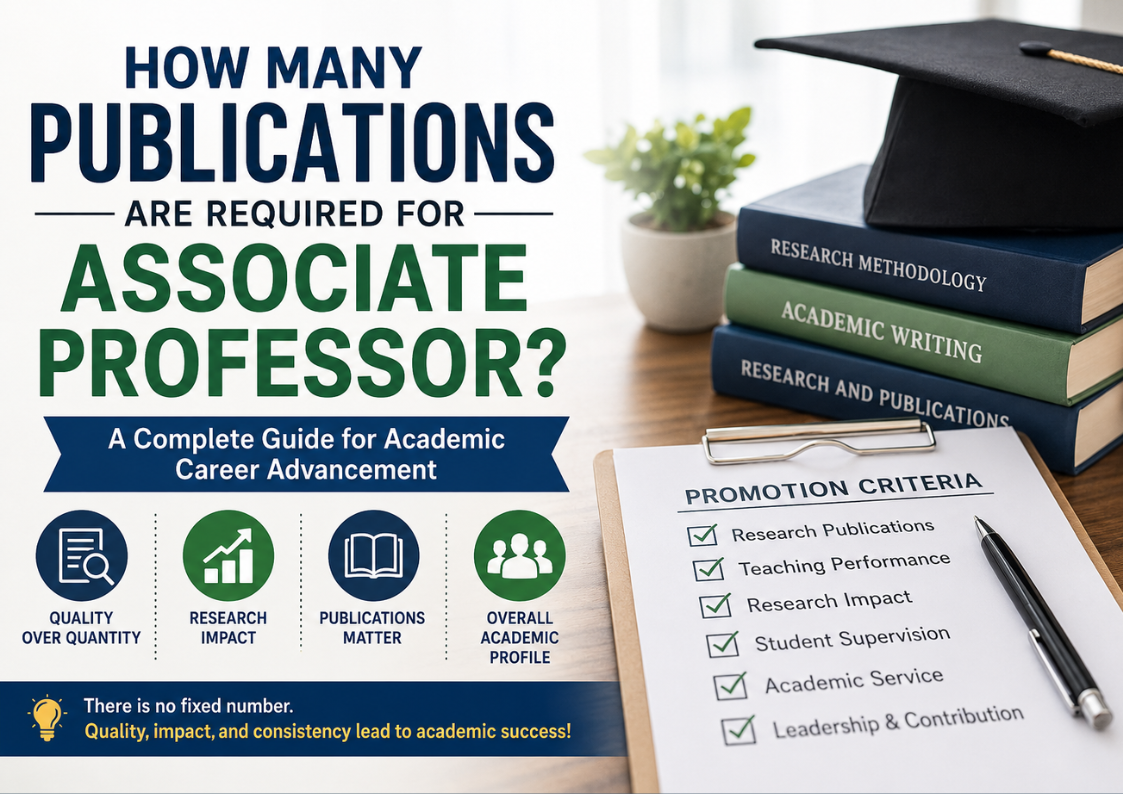
How many publications are required to become an Associate Professor?
There is no universal answer.
Different institutions maintain different standards.
Some universities may expect:
Others may require:
- 10–15 peer-reviewed articles
Research-intensive universities may expect:
The exact number depends on:
- Institutional expectations
- Discipline-specific norms
- Research output quality
- Publication impact
Increasingly, universities focus on publication quality rather than publication quantity.
Quality Matters More Than Quantity
Publishing numerous articles does not automatically guarantee promotion.
Promotion committees often evaluate:
Journal Reputation
Publications in respected journals carry greater weight.
Reviewers may consider:
- Editorial standards
- Peer-review quality
- Academic reputation
Research Impact
Committees examine whether research contributes meaningful knowledge to the field.
Research impact may be reflected through:
- Citations
- Academic discussion
- Practical applications
Originality
Novel and innovative research is often valued more highly than repetitive studies.
Indexing and Visibility
Many universities prefer publications indexed in recognized databases.
Examples include:
- Scopus
- Web of Science
- PubMed
- ABDC-listed journals
Publications in reputable indexed journals generally strengthen promotion applications.
Research Grants and Funding
Securing research funding is often viewed as evidence of scholarly credibility.
Grant success demonstrates:
- Research leadership
- Project management capability
- Academic recognition
Promotion committees frequently assess:
- External grants
- Internal research funding
- Collaborative research projects
- Sponsored research activities
Faculty members who successfully obtain funding often have a competitive advantage.
Citation Impact and Academic Influence
Modern promotion systems increasingly emphasize research influence.
Citation metrics help committees evaluate how widely a faculty member's work is recognized.
Important indicators may include:
- Citation counts
- h-index
- Research visibility
- Academic influence
Although citation expectations vary by discipline, a strong citation profile can significantly strengthen promotion applications.
Professional Service Requirements
Universities expect faculty members to contribute beyond teaching and research.
Professional service demonstrates commitment to the broader academic community.
Examples include:
Committee Participation
Faculty members often serve on:
- Academic committees
- Curriculum committees
- Research boards
- Quality assurance groups
Active participation reflects institutional engagement.
Peer Review Activities
Serving as a reviewer for scholarly journals indicates professional expertise.
Promotion committees often view peer-review contributions positively.
Conference Participation
Presenting research at conferences demonstrates scholarly involvement.
Activities may include:
- Paper presentations
- Session chairing
- Conference organization
Such contributions enhance academic visibility.
Editorial Responsibilities
Editorial roles can strengthen promotion portfolios.
Examples include:
- Editorial board membership
- Guest editor assignments
- Journal advisory positions
These roles indicate professional recognition within the discipline.
Student Research Supervision
Student supervision is frequently considered an important promotion criterion.
Universities often evaluate a candidate's involvement in:
- Undergraduate research projects
- Master's thesis supervision
- Doctoral supervision
- Research mentoring
Successful supervision demonstrates academic maturity and leadership.
Many institutions expect Associate Professor candidates to have guided multiple student research projects.
Academic Leadership Expectations
Promotion to Associate Professor often involves a transition toward leadership responsibilities.
Candidates may be expected to demonstrate:
Program Coordination
Examples include:
- Managing academic programs
- Coordinating courses
- Leading curriculum initiatives
Departmental Contributions
Faculty members who actively support departmental goals often receive positive evaluations.
Research Leadership
Leading research groups or collaborative projects reflects growing academic influence.
Leadership experiences help demonstrate readiness for more senior academic roles.
Experience Requirements
Most universities require a minimum period of service before promotion eligibility.
Common expectations range between:
- 4 to 7 years as Assistant Professor
However, timing varies significantly across institutions.
Promotion is generally based on demonstrated achievements rather than years alone.
Some universities allow accelerated promotion for exceptional candidates with outstanding records.
International Differences in Promotion Requirements
Promotion systems vary globally.
United States
American universities typically assess:
- Publications
- Teaching effectiveness
- Research funding
- Service contributions
Tenure-track systems often include promotion reviews after several years.
United Kingdom
UK institutions frequently focus on:
- Research excellence
- Teaching quality
- Academic impact
- Leadership contributions
Research assessment frameworks may influence promotion decisions.
India
Indian universities often evaluate:
- Academic Performance Indicators (APIs)
- Publications
- Teaching experience
- Research supervision
- Institutional service
National regulations and university policies play significant roles.
Australia and Canada
These systems generally emphasize:
- Research outputs
- Teaching effectiveness
- Community engagement
- Leadership activities
Promotion criteria are often highly transparent.
Common Reasons Promotion Applications Are Rejected
Many capable academics face delays in promotion because of avoidable weaknesses.
Insufficient Research Output
A limited publication record remains one of the most common reasons for unsuccessful applications.
Weak Publication Quality
Publishing primarily in low-impact or questionable journals may not satisfy committee expectations.
Lack of Institutional Service
Faculty members who focus exclusively on research may overlook important service responsibilities.
Limited Leadership Experience
Promotion committees often seek evidence of increasing academic leadership.
Poor Documentation
Strong achievements may be overlooked if not properly documented and presented.
Building a Strong Promotion Portfolio
Preparing for promotion should begin early in an academic career.
Develop a Long-Term Strategy
Create a professional development plan covering:
- Research goals
- Publication targets
- Teaching improvements
- Leadership opportunities
Strategic planning supports consistent growth.
Maintain Regular Research Activity
Steady publication output is generally more effective than sporadic bursts of productivity.
Keep Detailed Records
Document:
- Publications
- Grants
- Teaching achievements
- Service activities
- Awards and recognitions
Accurate records simplify promotion applications.
Seek Mentorship
Senior faculty members can provide valuable guidance regarding promotion expectations.
Learning from successful colleagues often helps candidates avoid common mistakes.
Diversify Contributions
Promotion committees prefer well-rounded candidates who contribute across multiple areas.
Balanced achievement in teaching, research, service, and leadership is often more persuasive than excellence in only one category.
What Promotion Committees Really Look For
Many faculty members believe promotion depends primarily on publication numbers.
In reality, committees typically ask broader questions:
- Has the candidate demonstrated sustained excellence?
- Is the candidate recognized within their field?
- Has the candidate contributed meaningfully to the institution?
- Does the candidate show leadership potential?
- Is the candidate prepared for greater academic responsibility?
The strongest applicants usually present evidence of growth across multiple dimensions of academic life.
Future Trends in Academic Promotion
Higher education is evolving rapidly, and promotion criteria continue to change.
Increasingly, universities are evaluating:
- Research impact rather than publication count alone
- Interdisciplinary collaboration
- Community engagement
- Industry partnerships
- Open-access contributions
- Innovation and societal impact
Future promotion systems are likely to place even greater emphasis on meaningful contributions rather than simple numerical metrics.
Final Thoughts
Promotion from Assistant Professor to Associate Professor is one of the most important milestones in an academic career. While requirements vary across institutions and disciplines, most universities evaluate candidates based on a combination of teaching excellence, research productivity, publication quality, student supervision, professional service, and academic leadership.
There is no single formula that guarantees promotion. However, faculty members who consistently publish high-quality research, contribute actively to their institutions, mentor students effectively, and demonstrate leadership potential are generally well-positioned for advancement.
Rather than focusing solely on meeting minimum requirements, aspiring Associate Professors should strive to build a balanced and impactful academic profile. Long-term commitment to scholarship, teaching, and service remains the most reliable path to successful promotion and lasting professional recognition in higher education.




No comments yet. Be the first!