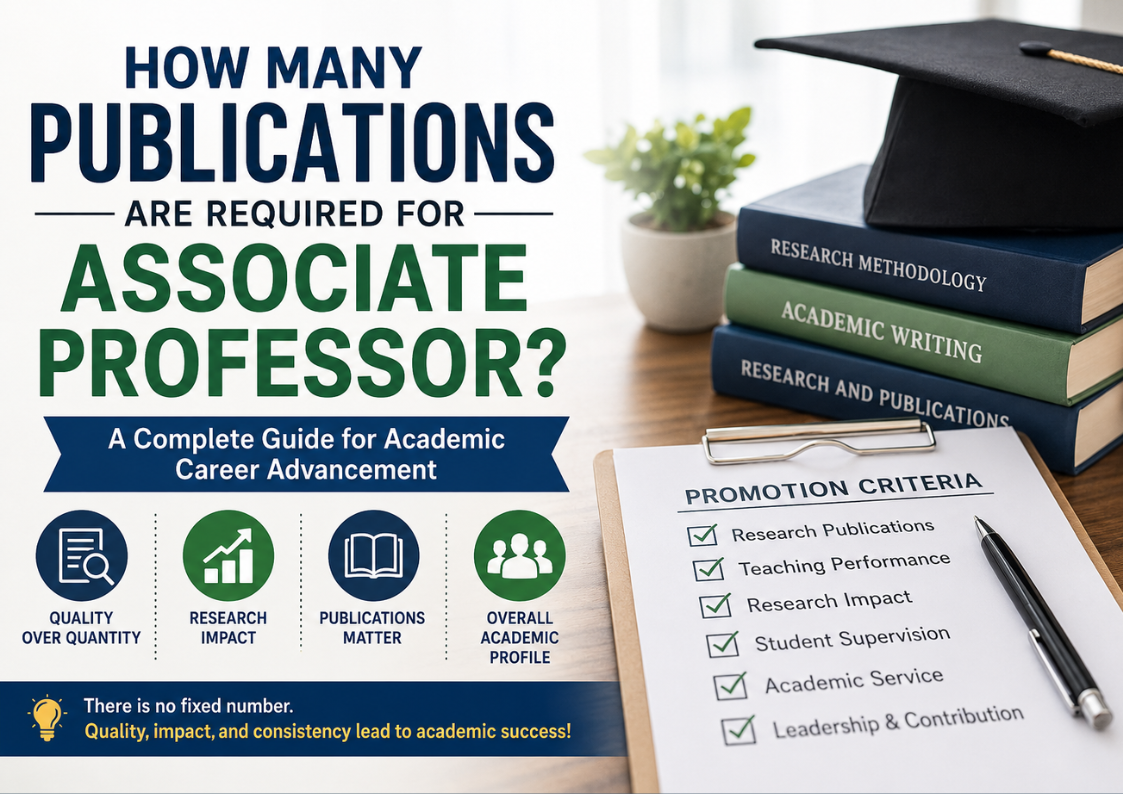
Becoming an Associate Professor is a significant milestone in an academic career. It represents years of dedication to teaching, research, student mentoring, and scholarly contributions. One of the most common questions asked by aspiring academics is: "How many publications are required for Associate Professor?"
The answer, however, is not as straightforward as many people expect. There is no universal number that applies to every university, country, or academic discipline. Publication requirements vary widely depending on institutional policies, accreditation standards, research expectations, and subject areas.
In today's competitive academic environment, publications play a crucial role in determining whether a faculty member is ready for promotion. Universities increasingly evaluate not only the quantity of publications but also their quality, impact, citations, and relevance to the field.
This guide explores publication requirements for Associate Professor positions, factors influencing promotion decisions, common expectations across institutions, and practical strategies to build a strong academic profile.
Understanding the Role of an Associate Professor
Before discussing publication requirements, it is important to understand what an Associate Professor position represents.
- Assistant Professor
- Associate Professor
- Professor
The Associate Professor rank is generally awarded to faculty members who have demonstrated:
- Strong teaching performance
- Consistent research productivity
- Academic leadership
- Student supervision experience
- Contributions to institutional development
- Professional service activities
Promotion to Associate Professor often signifies that an academic has established themselves as an independent researcher and educator.
Why Publications Matter in Academic Promotions
Research publications serve as evidence of scholarly contribution. Universities rely on publications to evaluate whether a faculty member is actively advancing knowledge in their discipline.
Publications help demonstrate:
- Research competence
- Subject expertise
- Intellectual contribution
- Innovation and originality
- Academic influence
- Professional reputation
A strong publication record indicates that a faculty member is actively engaged in research and contributes to ongoing academic discussions.
For this reason, publications are often one of the most heavily weighted factors during promotion reviews.
Is There a Fixed Number of Publications Required?
The simple answer is No.
There is no globally accepted minimum number of publications required to become an Associate Professor.
Different institutions have different criteria.
Some universities may require:
- 5 high-quality publications
Others may require:
Research-intensive universities may expect:
In many cases, the quality of publications is considered more important than the total number.
For example:
A faculty member with:
- 6 publications in highly respected international journals
may be viewed more favorably than someone with:
- 20 publications in low-impact journals
Therefore, publication quality often outweighs quantity.
Typical Publication Expectations Worldwide
Although requirements vary, certain patterns can be observed across academic institutions.
Research-Focused Universities
Research-intensive institutions generally have higher expectations.
Common requirements may include:
- 10–20 peer-reviewed publications
- Publications in indexed journals
- Evidence of citation impact
- International research collaborations
- Grant-funded research projects
Faculty members are expected to maintain a continuous research record over several years.
Teaching-Focused Universities
Institutions emphasizing teaching may have more flexible publication requirements.
Typical expectations include:
- 5–10 publications
- Demonstrated teaching excellence
- Curriculum development contributions
- Student mentoring activities
Research remains important, but teaching performance often receives greater emphasis.
Professional and Applied Universities
Applied universities frequently assess:
- Industry collaboration
- Applied research projects
- Professional contributions
- Practice-oriented publications
Publication expectations may be lower compared to research universities.
Publication Requirements in Different Academic Fields
Publication expectations vary significantly by discipline.
Science and Engineering
Fields such as:
- Physics
- Chemistry
- Engineering
- Biotechnology
often have higher publication rates.
Associate Professor candidates may possess:
- 10–25 publications
- Collaborative research papers
- Conference proceedings
- Funded research outputs
Medical Sciences
Medical and health sciences generally emphasize research productivity.
Candidates often have:
- Multiple journal publications
- Clinical research papers
- Collaborative studies
- Citation records
Publication numbers may range from 15 to 40 depending on specialization.
Social Sciences
Social science disciplines often prioritize:
- Journal articles
- Books
- Book chapters
- Policy research
Publication expectations are generally moderate compared to STEM fields.
Humanities
Humanities departments frequently value:
- Scholarly books
- Monographs
- Critical essays
- Peer-reviewed articles
A smaller number of high-quality publications can carry substantial weight.
Quality vs Quantity: Which Matters More?
One of the biggest misconceptions in academia is that promotion depends solely on publication count.
Modern universities increasingly focus on publication quality.
Important quality indicators include:
Journal Reputation
Publishing in respected journals demonstrates research credibility.
Promotion committees often examine:
- Peer-review standards
- Editorial quality
- Academic reputation
Indexing Status
Publications indexed in recognized databases are generally valued more highly.
Examples include:
- Scopus
- Web of Science
- PubMed
- ABDC-listed journals
Citation Impact
Citations indicate that other researchers are engaging with your work.
Higher citation counts often strengthen promotion applications.
Research Relevance
Promotion committees assess whether research contributes meaningfully to the field.
Original and impactful research is usually preferred over repetitive publications.
How Many Publications Are Considered Competitive?
Although exact numbers vary, the following ranges provide a general idea.
| Academic Competitiveness |
Typical Publications |
| Minimum Level |
5–8 |
| Moderate Competitiveness |
8–15 |
| Strong Candidate |
15–25 |
| Highly Competitive |
25+ |
These figures should only be viewed as general estimates.
Institutional policies always take precedence.
Other Factors Considered for Associate Professor Promotion
Publications are important, but they are rarely the only requirement.
Universities typically evaluate several areas.
Teaching Performance
Teaching evaluations often include:
- Student feedback
- Course outcomes
- Curriculum innovation
- Instructional effectiveness
Excellent teaching can strengthen a promotion application.
Research Grants
External funding demonstrates research capability.
Grant acquisition often indicates:
- Research leadership
- Project management skills
- Scholarly recognition
Many universities value funded research highly.
Student Supervision
Faculty members may be expected to supervise:
- Master's students
- PhD candidates
- Research assistants
Successful supervision contributes positively to promotion reviews.
Academic Service
Universities appreciate contributions such as:
- Committee participation
- Editorial board membership
- Conference organization
- Peer-review activities
These activities demonstrate commitment to the academic community.
Leadership Contributions
Academic leadership may include:
- Program coordination
- Department administration
- Research group management
Leadership experience can support promotion decisions.
First Author Publications: Are They Important?
Yes, in many cases.
Promotion committees often evaluate authorship positions.
First-author publications indicate that the researcher played a leading role in the study.
However, collaborative research is increasingly common.
Depending on institutional policies, committees may consider:
- First-author papers
- Corresponding-author papers
- Co-authored publications
The emphasis varies by discipline and university.
Do Books Count Toward Promotion?
In many disciplines, especially humanities and social sciences, books are highly valued.
Relevant scholarly outputs may include:
- Academic books
- Edited volumes
- Book chapters
- Research monographs
In some fields, a well-regarded scholarly book can significantly strengthen an Associate Professor application.
What About Conference Papers?
Conference papers can contribute to an academic profile, especially in fields such as:
- Computer Science
- Engineering
- Information Technology
However, many universities place greater emphasis on peer-reviewed journal publications.
Conference papers are often considered supplementary evidence of research activity.
Common Mistakes Faculty Members Make
Many academics delay promotion because of avoidable mistakes.
Focusing Only on Quantity
Publishing numerous low-quality papers may not impress promotion committees.
Quality should remain the primary focus.
Ignoring Citation Impact
Researchers sometimes publish frequently but neglect visibility and citations.
Promoting research ethically can improve academic impact.
Publishing in Predatory Journals
Publications in questionable journals may not be recognized by universities.
Researchers should carefully evaluate journal credibility before submission.
Delaying Research Activities
Waiting several years before building a publication record can make promotion more difficult.
Consistent publishing is generally more effective.
Neglecting Academic Networking
Collaborations often lead to stronger research outcomes and increased publication opportunities.
How to Build a Strong Publication Record
Faculty members aspiring to become Associate Professors can benefit from a strategic approach.
Develop a Research Plan
Create a multi-year publication roadmap.
Identify:
- Research interests
- Target journals
- Collaboration opportunities
Long-term planning improves consistency.
Publish Regularly
Rather than producing many papers at once, aim for steady research output.
Consistent publication demonstrates sustained scholarly activity.
Collaborate with Researchers
Collaborative projects often produce:
- Higher-quality studies
- Broader expertise
- Increased visibility
Partnerships can accelerate research productivity.
Target Reputable Journals
Choose journals that align with your discipline and research objectives.
A smaller number of quality publications is often more valuable.
Improve Research Visibility
Researchers can increase impact through:
- Academic networking
- Conference presentations
- Professional platforms
- Institutional repositories
Greater visibility often leads to higher citation rates.
What Promotion Committees Really Want
Many academics focus entirely on publication numbers, but promotion committees usually adopt a broader perspective.
They often ask:
- Has the candidate established a sustainable research program?
- Is the research recognized by peers?
- Does the candidate contribute meaningfully to the institution?
- Has the candidate demonstrated academic leadership?
- Is there evidence of future scholarly growth?
The strongest candidates typically present a balanced profile combining research, teaching, service, and leadership.
Future Trends in Associate Professor Promotions
Academic evaluation is evolving rapidly.
Increasingly, universities are considering factors beyond traditional publication counts.
Emerging evaluation criteria include:
- Research impact
- Interdisciplinary collaboration
- Community engagement
- Open-access contributions
- Innovation and technology transfer
- Societal relevance of research
As a result, future promotion systems may focus more on meaningful contributions than simply counting publications.
Final Thoughts
So, how many publications are required for Associate Professor?
The most accurate answer is that there is no universal number. Depending on the institution, discipline, and country, expectations can range from as few as five quality publications to more than twenty highly impactful research papers.
However, promotion committees increasingly prioritize quality over quantity. Publishing in reputable journals, achieving meaningful research impact, contributing to teaching excellence, supervising students, and participating in academic leadership activities all play important roles in promotion decisions.
For academics aiming to become Associate Professors, the best strategy is not to chase publication numbers alone. Instead, focus on producing high-quality research, maintaining consistent scholarly activity, and building a well-rounded academic profile. A balanced combination of research excellence, teaching effectiveness, and professional service remains the strongest foundation for long-term academic success and career advancement.




No comments yet. Be the first!