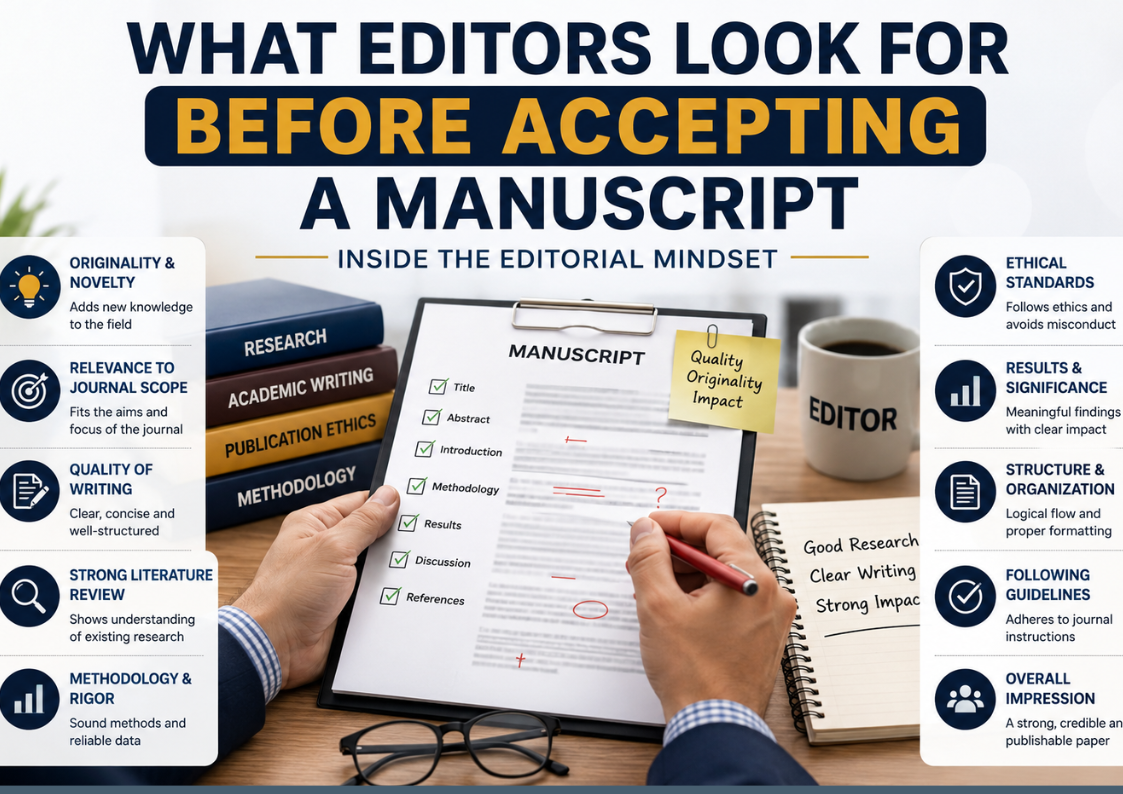
Publishing a research paper in a reputed academic journal is a major achievement for researchers, PhD scholars, and faculty members. However, before a manuscript reaches peer reviewers, it first passes through the editor’s evaluation process. In many cases, manuscripts are rejected at this initial stage, commonly known as “desk rejection,” even before detailed review begins. This is why understanding what editors look for before accepting a manuscript is extremely important for every researcher.
Editors act as gatekeepers of academic quality. Their responsibility is not only to select publishable research but also to maintain the reputation, integrity, and scholarly standards of the journal. Because journals receive large numbers of submissions, editors must quickly determine whether a manuscript fits the journal’s scope and meets its quality expectations.
Many researchers believe that only the research results matter. In reality, editors evaluate multiple aspects including originality, structure, language quality, research ethics, methodology, relevance, and formatting. A manuscript with strong research can still face rejection if it lacks clarity, professionalism, or alignment with the journal’s objectives.
In 2026, academic publishing has become more competitive than ever. Journals are receiving increasing numbers of submissions from researchers worldwide, making editorial evaluation stricter and more selective. Understanding how editors think and what influences their decisions can significantly improve the chances of manuscript acceptance.
This article explores the key factors editors evaluate before accepting a manuscript and explains how researchers can strengthen their submissions for successful publication.
Understanding the Editor’s Role in Academic Publishing
The editor plays one of the most critical roles in scholarly publishing. Before a manuscript reaches peer reviewers, editors conduct an initial assessment to determine whether the paper is suitable for the journal. This evaluation helps journals save time and ensures that reviewers only examine manuscripts with reasonable publication potential.
Editors are responsible for protecting the quality and credibility of the journal. They evaluate whether the research contributes meaningful knowledge, whether the methodology is reliable, and whether the manuscript meets publishing standards.
In many cases, editors make decisions quickly based on the overall impression created by the manuscript. A poorly structured or carelessly written paper may receive rejection even if the research idea is valuable. This is why first impressions matter significantly during the editorial screening process.
Originality and Research Contribution
One of the first things editors evaluate is originality. Academic journals seek research that contributes something new to the field rather than repeating already established findings.
Editors ask important questions during this stage. Does the manuscript address a meaningful research gap? Does it provide fresh insights or innovative approaches? Does it contribute to ongoing academic discussions?
A paper that lacks novelty often struggles to move forward in the review process. Researchers should clearly explain the significance of their study in the introduction and demonstrate how their work differs from previous research.
Originality does not always mean discovering something entirely new. It can also involve applying existing theories in new contexts, introducing improved methodologies, or offering updated perspectives on important issues.
When editors can immediately recognize the value and uniqueness of a study, the manuscript gains a stronger chance of proceeding to peer review.
Relevance to the Journal’s Scope
Even high-quality manuscripts can face rejection if they do not match the journal’s aims and scope. Editors carefully evaluate whether the topic aligns with the journal’s audience and publishing focus.
Researchers sometimes submit manuscripts to journals simply because they are indexed or prestigious without considering whether the journal regularly publishes research in that area. This mismatch often leads to immediate rejection.
Before submission, researchers should carefully examine the journal’s objectives, recently published articles, and thematic focus. A manuscript that clearly fits the journal’s research interests creates a positive impression during editorial evaluation.
Editors prefer manuscripts that contribute directly to the conversations and disciplines represented by the journal. Relevance is therefore a crucial factor in the acceptance process.
Quality of Academic Writing
Language quality strongly influences editorial decisions. Editors expect manuscripts to be written clearly, professionally, and logically. Poor grammar, unclear arguments, and confusing structure can create doubts about the quality of the research itself.
A well-written manuscript demonstrates professionalism and respect for academic standards. Editors appreciate papers that communicate ideas effectively without unnecessary complexity.
Strong academic writing involves more than grammar correction. It includes logical flow, coherent arguments, appropriate terminology, and clear explanations of concepts and findings.
Researchers who struggle with academic English often benefit from proofreading services or feedback from experienced colleagues before submission. Improving writing quality can significantly increase the chances of passing editorial screening.
Clarity of Research Objectives
Editors want to understand the purpose of the study immediately. Manuscripts with vague or poorly defined objectives often create confusion and weaken the impact of the research.
The introduction should clearly explain the research problem, objectives, and significance of the study. Editors should be able to identify the main focus of the research within the first few paragraphs.
Clear objectives also help establish the logical structure of the paper. When the research question is well-defined, the methodology, analysis, and conclusions become easier to evaluate.
A manuscript with strong focus and direction demonstrates that the researcher has carefully planned the study rather than conducting unfocused or disconnected analysis.



No comments yet. Be the first!