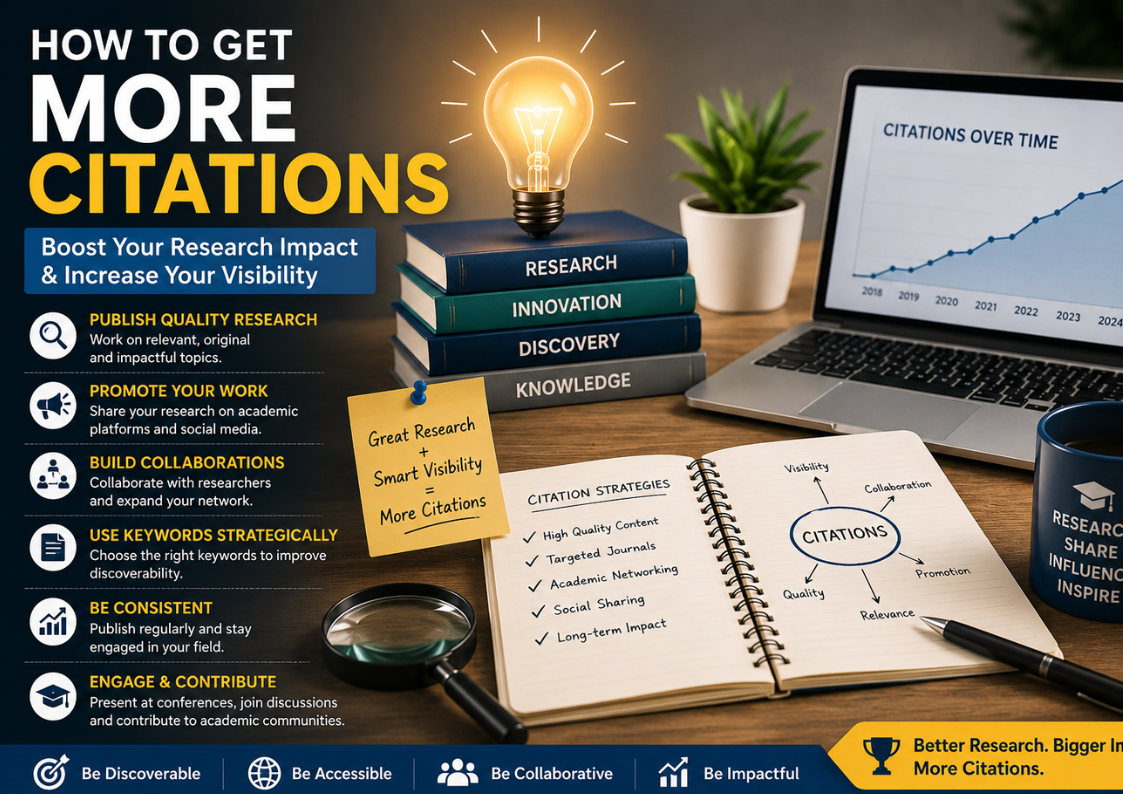
In the competitive landscape of academia, simply publishing your research isn't enough. To truly make an impact, your work needs to be visible, accessible, and citable. This is where Open Access (OA) comes in, fundamentally transforming how scholarly information is disseminated and consumed.

For researchers aiming to maximize their reach, increase citations, and amplify their H-index, understanding Open Access, strategic repository selection, and Creative Commons (CC) licensing is paramount. At Powerline Research Publication, we guide authors not just to publication, but to impactful publication.

1. What is Open Access and Why Does It Matter for Your Research?

Open Access refers to the practice of providing unrestricted access to peer-reviewed scholarly research. Unlike traditional subscription models, OA content is free for anyone to read, download, copy, distribute, print, search, and link to.

Why is this critical for researchers?

  • Increased Visibility & Citations: Studies consistently show that OA articles are cited more frequently than their paywalled counterparts. More eyes on your work means a higher chance of being integrated into other scholars' research.

  • Faster Dissemination: OA breaks down paywalls, allowing your research to reach a global audience instantly, including researchers in developing countries, policymakers, and the general public, fostering broader societal impact.

  • Enhanced H-Index: More citations directly contribute to a higher H-index, strengthening your academic profile for tenure, promotions, and grant applications.

  • Compliance with Funder Mandates: Many research funders now require grant recipients to make their publications openly accessible.

At Powerline Research Publication, we advocate for OA not just as a principle, but as a strategic tool for career advancement.

2. Choosing the Right Open Access Route: Gold, Green, and Hybrid

There are primarily three paths to Open Access:

  • Gold Open Access: The article is immediately made open access by the publisher upon publication. This usually involves an Article Processing Charge (APC) paid by the author (or their institution/funder). The publisher then makes the final published version freely available.

    • Example: Publishing in a fully OA journal listed in the Directory of Open Access Journals (DOAJ).

  • Green Open Access (Self-Archiving): The author publishes in a traditional subscription journal but also deposits a version of their manuscript (usually the accepted manuscript, sometimes the submitted version or the final published PDF, depending on publisher policy) into an institutional or subject-specific repository. This version becomes openly accessible after an embargo period, if any.

    • Example: Uploading your accepted manuscript to your university's institutional repository.

  • Hybrid Open Access: A traditional subscription journal offers authors the option to pay an APC to make their individual article open access, while the rest of the journal remains subscription-based. This can be costly and is sometimes viewed as "double dipping" by publishers.

Powerline Research Publication helps you navigate these options, ensuring you choose a path that aligns with your budget, funder requirements, and publication goals.

3. Strategic Repository Selection: Where to Deposit Your Work

Once you decide on Green Open Access or simply want to archive your Gold OA paper for added discoverability, selecting the right repository is crucial.


A. Institutional Repositories (IRs)

  • What they are: Digital archives maintained by universities and research institutions to collect, preserve, and disseminate the scholarly output of their faculty and researchers.

  • Benefits:

    • Visibility for Your Institution: Showcases your affiliation and contributes to your institution's scholarly profile.

    • Long-Term Preservation: IRs are typically well-funded and committed to long-term data integrity.

    • Funder Compliance: Often the preferred method for meeting institutional or funder OA mandates.

  • Powerline Recommendation: Always prioritize depositing your work in your own institution's repository if available. It boosts your institutional profile and provides a stable URL for your work.


B. Subject-Specific Repositories

  • What they are: Archives dedicated to specific disciplines, pre-dating many IRs.

    • Examples:

      • arXiv (Physics, Mathematics, Computer Science, Quantitative Biology, etc.)

      • PubMed Central (Biomedical and Life Sciences)

      • SSRN (Social Science Research Network) (Social Sciences, Humanities, Law)

      • Zenodo (Across all disciplines, also hosts data sets)

  • Benefits:

    • Community Engagement: Your work is immediately visible to a highly relevant audience actively searching within your field.

    • Pre-prints & Rapid Dissemination: Many allow for pre-prints, enabling you to share early versions of your work before formal peer review, establishing priority.

    • Enhanced Discoverability: Highly indexed by disciplinary search engines.

  • Powerline Recommendation: For Green OA, consider a subject-specific repository in addition to your institutional repository for maximum reach within your niche. Check journal policies carefully regarding pre-print servers.

4. Creative Commons Licenses: Understanding Your Rights and Permissions

When you make your work Open Access, Creative Commons (CC) licenses provide a standardized way to grant permissions for others to use your work while retaining your copyright. Choosing the right license is a strategic decision.


Key CC Licenses and Their Implications:

  • CC BY (Attribution): This is the most liberal and recommended OA license. Others can distribute, remix, adapt, and build upon your work, even commercially, as long as they credit you for the original creation.

    • Benefit: Maximizes reach and reuse, leading to higher citation potential. Often mandated by funders.

  • CC BY-SA (Attribution-ShareAlike): Allows others to remix, adapt, and build upon your work even for commercial purposes, as long as they credit you and license their new creations under identical terms.

  • CC BY-NC (Attribution-NonCommercial): Allows others to remix, adapt, and build upon your work non-commercially, and although their new works must also acknowledge you and be non-commercial, they don’t have to license their derivative works on the same terms.

  • CC BY-ND (Attribution-NoDerivatives): Allows for redistribution, commercial and non-commercial, as long as it is passed along unchanged and in whole, with credit to you.

    • Benefit: Ensures your work is used exactly as you created it, but limits adaptations.

  • CC BY-NC-SA (Attribution-NonCommercial-ShareAlike): Allows others to remix, adapt, and build upon your work non-commercially, as long as they credit you and license their new creations under identical terms.

  • CC BY-NC-ND (Attribution-NonCommercial-NoDerivatives): This is the most restrictive CC license. It only allows others to download your works and share them with others as long as they credit you, but they can’t change them in any way or use them commercially.

Powerline Research Publication generally advises authors to opt for CC BY when possible, as it aligns best with the principles of maximum reach and open science, often leading to greater scholarly engagement. We help you understand journal policies regarding CC licenses and ensure compliance.

Conclusion: Amplify Your Impact with Powerline Research Publication

Open Access is more than a trend; it's the future of scholarly communication and a powerful tool for career advancement. By strategically choosing your OA route, leveraging appropriate repositories, and selecting the right Creative Commons license, you can ensure your research resonates globally.

At Powerline Research Publication, our expertise extends beyond getting your paper accepted. We equip you with the knowledge and support to ensure your published work achieves its full potential in terms of visibility, impact, and ultimately, your H-index. Let us help you navigate the complexities of Open Access to truly maximize your reach.

Ready to make your research accessible and impactful?

🔗 Partner with Powerline Research Publication today for expert guidance on your next publication.