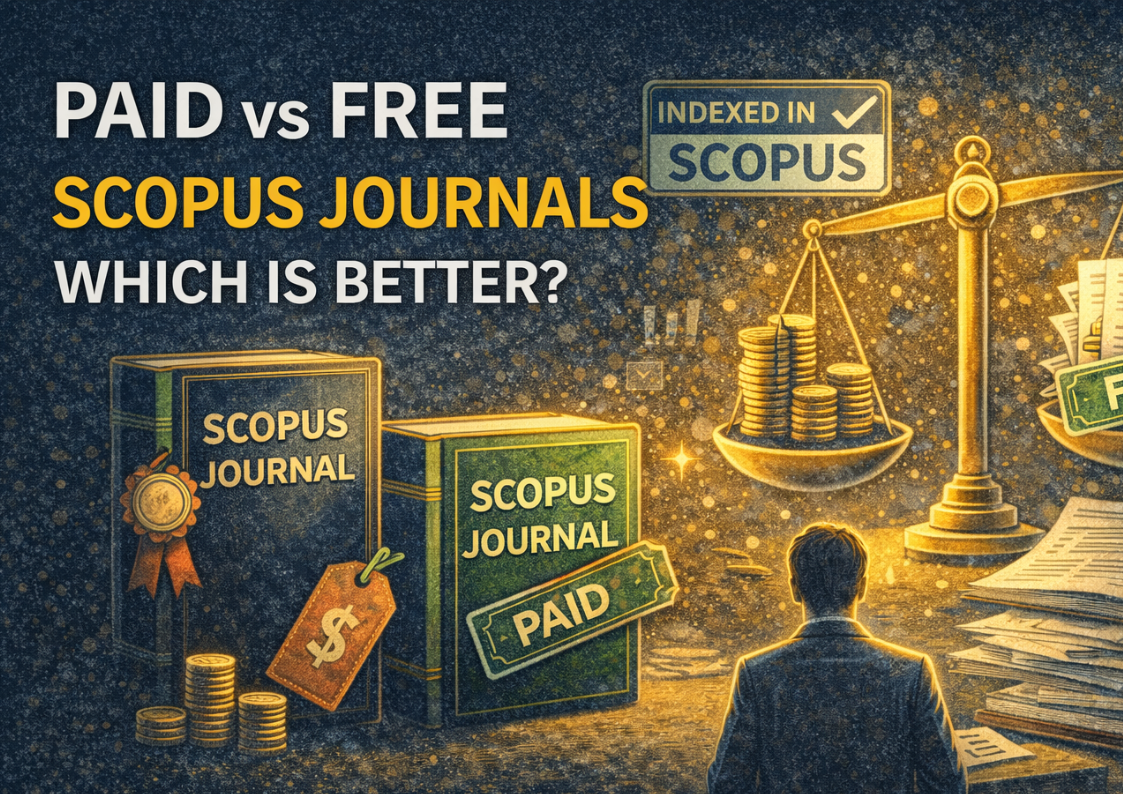
Publishing in Scopus-indexed journals has become one of the most important goals for researchers, PhD scholars, and academic professionals around the world. Universities, research institutions, and promotion committees increasingly emphasize publications in reputable indexed journals, and Scopus is widely considered one of the most trusted abstract and citation databases for scholarly literature. Because of this growing importance, researchers frequently face an important question during the publication process: should they choose a paid Scopus journal or a free Scopus journal?
The debate between paid and free journals often creates confusion, especially for early-career researchers who are new to academic publishing. Some researchers believe that paid journals provide faster publication and better visibility, while others believe that free journals maintain stronger academic integrity and credibility. The reality is more nuanced. Both paid and free Scopus journals can be legitimate and high-quality, but understanding how they operate is essential before submitting a research manuscript.
In academic publishing, the distinction between paid and free journals does not necessarily determine the quality of the journal. Instead, the difference usually lies in the journal’s publishing model. Some journals charge authors an article processing charge, while others cover publishing costs through institutional support, subscriptions, or academic organizations. Understanding how these models work can help researchers make informed decisions and avoid common misconceptions.
This article explores the differences between paid and free Scopus journals, explains how the publishing process works, and helps researchers understand which option might be more suitable for their research goals.
Understanding the Scopus Indexing System
Before discussing paid and free journals, it is important to understand what Scopus indexing means. Scopus is a large academic database that indexes peer-reviewed journals across various disciplines, including science, technology, medicine, social sciences, and humanities. Journals included in this database must meet specific quality standards related to editorial policies, peer review processes, citation impact, and publishing ethics.
Because Scopus evaluates journals through strict selection criteria, being indexed in this database generally indicates that the journal maintains a certain level of academic credibility. However, the indexing status alone does not reveal whether the journal charges authors for publication.
Researchers sometimes assume that a Scopus-indexed journal must always be free or always be paid. In reality, both publishing models exist within the Scopus ecosystem, and the key factor is not the fee itself but the transparency and quality of the journal’s editorial practices.
What Are Free Scopus Journals?
Free Scopus journals are academic journals that do not charge authors any publication fee for submitting or publishing their research papers. These journals typically operate under traditional publishing models, where the costs of publication are covered by universities, academic societies, research organizations, or subscription-based access systems.
In many cases, free journals rely on institutional funding or academic sponsorship to support their operations. Because of this support, authors can publish their research without paying article processing charges. For researchers who have limited funding, free journals provide an excellent opportunity to share their work with the academic community.
Free journals often maintain strong editorial standards and rigorous peer review processes. In fact, many prestigious academic journals that have existed for decades operate without charging authors for publication. These journals may take longer to process manuscripts because they receive a large number of submissions and carefully review each one before making editorial decisions.
For researchers who prioritize credibility and long-term academic impact, free Scopus journals can be a very attractive option. However, the review and publication timelines may sometimes be longer compared to some open-access journals.
Understanding Paid Scopus Journals
Paid Scopus journals usually operate under an open-access publishing model. In this system, authors pay an article processing charge, often referred to as an APC, after their paper has been accepted for publication. This fee helps cover the costs associated with peer review management, editorial work, website maintenance, digital publishing, and long-term article archiving.
One of the main advantages of open-access publishing is that the published research becomes freely accessible to readers around the world. Anyone can read, download, and share the article without subscription barriers. This accessibility often increases the visibility and citation potential of the research.
Many reputable international publishers use the open-access model, and the presence of an article processing charge does not automatically indicate poor quality. In fact, several well-known publishers charge APCs while maintaining strong peer review systems and strict editorial policies.
However, researchers must be careful when evaluating paid journals. The academic publishing landscape has also seen the rise of predatory journals that charge high fees without conducting proper peer review. These journals often promise extremely fast publication timelines and may falsely claim indexing in major databases.
Therefore, the key consideration is not whether a journal charges a fee, but whether it follows transparent and ethical publishing practices.
Comparing Quality and Credibility
One of the most common misconceptions in academic publishing is that free journals are always better or more trustworthy than paid journals. In reality, quality depends on the editorial standards of the journal rather than the publication fee.
Both paid and free journals can maintain strong peer review processes, experienced editorial boards, and high academic standards. Similarly, both models can also include journals of varying quality. Researchers should therefore evaluate journals based on factors such as editorial transparency, indexing verification, peer review policies, and publication ethics.
A credible journal usually provides detailed information about its editorial board, submission guidelines, peer review process, and publication policies. Reputable journals also assign digital object identifiers to published articles, ensuring that the research can be permanently identified and cited.
When researchers focus on these quality indicators rather than simply the presence or absence of publication fees, they are more likely to select journals that align with academic standards.





No comments yet. Be the first!