Writing an abstract is one of the most important parts of preparing a research paper. Although an abstract is usually much shorter than the main paper, it has a very important job. It gives readers a quick understanding of what the research is about, why the study was conducted, how it was carried out, what was found, and what those findings mean.
For many students and early-career researchers, writing an abstract can be difficult. The main challenge is not having enough information. In fact, the opposite is usually true. A research paper may contain thousands of words, while the abstract may need to explain the entire study in only a few hundred words.
A good abstract requires careful selection of information. It should contain the most important points without becoming a shortened copy of the introduction or conclusion. It should also be clear enough for someone to understand the basic purpose and findings of the research without reading the entire paper.
This guide explains how to write an abstract step by step. It covers the different types of abstracts, the structure of an effective abstract, common mistakes, keyword selection, formatting, and practical tips that can help you write a stronger abstract for a research paper, thesis, dissertation, conference paper, or journal submission.
What Is an Abstract?
An abstract is a short summary of an academic or research document. It normally appears at the beginning of a research paper, immediately after the title and author information.
The abstract gives readers a brief overview of the study. Depending on the type of research, it may include the research problem, objective, methodology, main findings, and conclusion.
Think of the abstract as a window into your research. A reader should be able to understand the basic purpose and outcome of your study without having to read the complete paper.
For example, if your paper examines the impact of artificial intelligence on higher education, the abstract should tell readers what aspect of AI you investigated, what method you used, what you discovered, and what the findings suggest.
An abstract is not simply an introduction. It represents the research paper as a whole.
Why Is an Abstract Important?
The abstract is often the first substantial part of a research paper that a reader encounters. In academic databases, search results frequently display the title and abstract before the reader opens the complete article.
This makes the abstract important for several reasons.
A well-written abstract can help:
-
Readers understand the purpose of your research.
-
Researchers decide whether your paper is relevant to their work.
-
Editors quickly assess whether a manuscript fits a journal.
-
Conference committees evaluate research submissions.
-
Students identify useful sources for their literature review.
-
Search engines and academic databases categorize your research.
A strong abstract can therefore improve the discoverability and usefulness of your research.
However, an abstract should not be written simply to attract attention. Its main purpose is to communicate the research accurately and efficiently.
How Long Should an Abstract Be?
There is no universal word limit for abstracts.
The required length depends on the journal, university, conference, or organization. Some journals request abstracts of around 150 words, while others may allow 250, 300, or more words.
A thesis or dissertation may have a different requirement from a journal article.
Before writing your abstract, always check the guidelines provided by the target journal or institution.
If no specific word limit is provided, keeping the abstract concise is generally a good approach. Every sentence should contribute useful information.
A common mistake is trying to make an abstract sound impressive by adding unnecessary background information. This uses valuable space without helping the reader understand the research.
Types of Abstracts
Before writing your abstract, determine which type is appropriate for your document.
The two most common types are descriptive abstracts and informative abstracts.
Descriptive Abstract
A descriptive abstract provides a general overview of the subject and purpose of the paper.
It may mention:
-
The research topic
-
The purpose of the paper
-
The general scope
-
The approach taken
It usually does not provide detailed findings or conclusions.
Descriptive abstracts are sometimes used for essays, reviews, conference programs, and humanities-related work.
Informative Abstract
An informative abstract provides a more complete summary of the research.
It generally includes:
Informative abstracts are common in scientific, technical, social science, business, medical, and other research publications.
If you are writing a standard research paper, an informative abstract is often the more useful format unless the journal specifies otherwise.
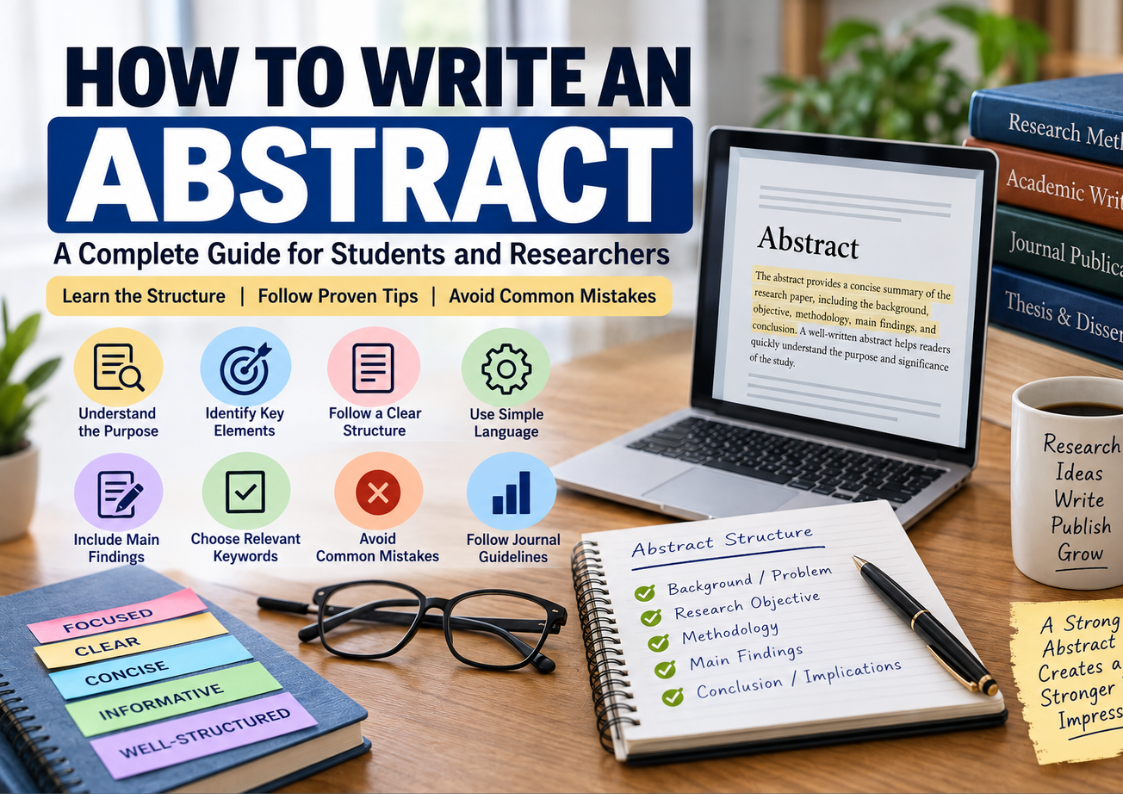
The Basic Structure of a Research Abstract
Although requirements vary between journals and disciplines, a research abstract commonly answers five important questions:
What is the problem?
Why was the research conducted?
How was the research conducted?
What were the main findings?
What do the findings mean?
These questions can be converted into five basic components:
-
Background or research problem
-
Research objective
-
Methodology
-
Results
-
Conclusion or implications
You do not necessarily need separate headings for each component. In many journals, the abstract is written as one paragraph.
Step 1: Start With the Research Problem
The opening of your abstract should establish the context of your research.
You do not need to provide a long history of the subject. A sentence or two is usually enough to explain the problem that motivated the study.
For example:
"The rapid adoption of artificial intelligence in higher education has created new opportunities for personalized learning, but questions remain about its effect on student engagement."
This immediately tells the reader what the issue is.
Avoid beginning with extremely broad statements such as:
"Technology has changed the world."
Statements like this take up space without providing useful information about your actual study.
Instead, move quickly toward the specific research problem.
Step 2: State the Research Objective
After introducing the problem, explain what your research attempted to investigate.
Useful phrases include:
-
"This study examines..."
-
"The purpose of this study is to..."
-
"This research investigates..."
-
"The study aims to evaluate..."
-
"This paper explores..."
For example:
"This study examines the relationship between the use of AI-based learning tools and student engagement in undergraduate education."
The objective should match the research question and should not introduce a completely different subject.
One of the most common weaknesses in abstracts is a mismatch between the stated objective and the actual research paper.
Before finalizing your abstract, compare the objective in the abstract with the objectives in your main manuscript.
Step 3: Briefly Explain the Methodology
Readers need to know how you conducted the research.
You do not need to explain every methodological detail. The abstract should provide only enough information to establish the nature of the study.
Depending on your research, you might mention:
-
Research design
-
Sample or participants
-
Data source
-
Data collection method
-
Analytical method
For example:
"A survey was conducted among 250 undergraduate students, and the collected responses were analyzed using descriptive statistics and regression analysis."
This is much more useful than simply saying:
"A quantitative method was used."
Whenever possible, provide enough detail to make the research approach understandable.
Step 4: Present the Main Findings
The results are often the most important part of the abstract.
Readers want to know what your research actually discovered.
Avoid vague statements such as:
"The study produced interesting results."
Instead, summarize the major findings.
For example:
"The findings indicate that students who regularly used AI-supported learning tools reported higher levels of engagement than students who relied primarily on traditional learning resources."
If your study produced numerical findings that are particularly important, you may include selected figures.
However, do not fill the abstract with statistics. Include only the results that directly answer your research questions.
Step 5: End With the Main Conclusion
The final part of the abstract should explain what the findings mean.
This does not require repeating the entire conclusion section of your paper.
Instead, provide a concise statement about the significance or implication of the research.
For example:
"The findings suggest that carefully integrated AI-based learning tools may support student engagement, although effective implementation requires appropriate academic guidance and digital infrastructure."
The conclusion should be supported by your research findings.
Do not make claims that go beyond what your study actually demonstrates.
A Simple Formula for Writing an Abstract
A useful way to remember the structure is:
Problem → Objective → Method → Results → Conclusion
For example:
Problem: What issue does the study address?
Objective: What did you investigate?
Method: How did you conduct the research?
Results: What did you discover?
Conclusion: Why do those findings matter?
If your abstract answers these five questions clearly, it will usually provide readers with a useful overview of your research.
Example of a Research Abstract Structure
Imagine that your research examines online learning and student performance.
A basic structure could look like this:
Background: Online learning has become an important part of higher education, but student performance may vary depending on the learning environment.
Objective: This study examines the relationship between online learning practices and academic performance among university students.
Method: Data were collected through a structured questionnaire and academic performance records from selected students.
Results: The analysis found a positive relationship between regular participation in online learning activities and academic performance.
Conclusion: The findings indicate that well-structured online learning environments can support academic performance when students receive adequate instructional and technical support.
This is not meant to be copied into another paper. It simply demonstrates how the different components fit together.
Write the Abstract After Completing the Research
Although the abstract appears at the beginning of a paper, it is often easier to write it after completing the main manuscript.
Why?
Because your abstract needs to reflect the final version of your research.
If you write the abstract before completing the study, you may not yet know:
-
The final methodology
-
The actual sample size
-
The final results
-
The important findings
-
The final conclusion
Writing the abstract at the end reduces the possibility of creating inconsistencies.
You can still prepare a temporary summary during the early stages of writing, but the final abstract should be checked against the completed manuscript.
How to Choose Keywords for an Abstract
Many research papers include keywords immediately below the abstract.
Keywords help readers and academic databases understand the subject of your research.
For example, a paper about AI in higher education might use:
Keywords: Artificial intelligence, higher education, student engagement, digital learning, educational technology
Choose keywords that accurately represent the central concepts of your study.
Avoid:
Usually, a small group of highly relevant keywords is better than a long list.
Always follow the keyword requirements of the journal or conference.
How to Make an Abstract More Search-Friendly
Researchers often discover papers through academic search engines and databases. This means the wording of your title and abstract can influence how easily your research is discovered.
Use important subject-specific terms naturally in the abstract.
For example, if your paper studies "machine learning for financial fraud detection," those concepts should appear naturally in the title or abstract where appropriate.
However, avoid keyword stuffing.
The abstract should be written primarily for human readers. Search visibility should be achieved through clear and relevant terminology rather than unnatural repetition.
Common Mistakes to Avoid When Writing an Abstract
Even a strong research paper can have a weak abstract. Here are some common mistakes.
1. Making the Abstract Too Long
An abstract should summarize the research, not reproduce the paper.
Remove unnecessary background and detailed explanations.
2. Writing a Vague Abstract
Statements such as "The study discusses important issues" do not tell readers what you actually discovered.
Be specific.
3. Including Information That Is Not in the Paper
Every major claim in the abstract should correspond to information presented in the main paper.
Do not add findings that are not discussed later.
4. Adding Too Many References
Most research abstracts do not require citations. Unless the journal specifically allows or requests them, keep references out of the abstract.
5. Introducing New Arguments
The abstract is not the place to introduce an argument that does not appear in the main paper.
6. Using Excessive Technical Language
Specialized terminology may be necessary, but unnecessary jargon can make your abstract difficult to understand.
Use technical terms when they are important to the research, but explain the study in straightforward language.
7. Repeating the Title
Do not waste the opening sentences simply restating the title.
Move directly into the research problem and objective.
8. Focusing Only on the Background
A common beginner mistake is spending most of the abstract explaining why the topic is important while barely mentioning the findings.
Remember that readers want to know what your research discovered.
Abstract Writing for Different Types of Research
The structure of an abstract may change depending on the type of study.
Quantitative Research
A quantitative abstract commonly includes:
-
Research problem
-
Objective
-
Sample
-
Data collection
-
Statistical methods
-
Major results
-
Conclusion
Important numerical findings may be included where appropriate.
Qualitative Research
A qualitative abstract may emphasize:
-
Research context
-
Research question
-
Participants
-
Data collection
-
Analytical approach
-
Major themes
-
Interpretation
The focus is generally on understanding experiences, perceptions, behaviors, or social processes.
Review Papers
A review article may not have primary data collection.
Its abstract may instead describe:
Systematic reviews may have more detailed requirements concerning databases, search strategies, and study selection.
Structured vs Unstructured Abstracts
Some journals require an unstructured abstract written as a single paragraph.
Others require a structured abstract with headings such as:
Background
Objective
Methods
Results
Conclusion
Structured abstracts can make research easier to scan because readers can immediately locate the information they need.
Always check the author's guidelines of your target journal before choosing a format.
How to Improve the Language of Your Abstract
Academic writing does not need to sound unnecessarily complicated.
A clear abstract is usually more effective than one filled with complicated vocabulary.
Instead of:
"The present investigation endeavors to elucidate the multifaceted ramifications associated with..."
write:
"This study examines the effects of..."
Simple language does not make academic writing less professional. In many cases, it makes the research easier to understand.
Try to:
-
Use direct sentences.
-
Avoid unnecessary adjectives.
-
Remove repeated ideas.
-
Use precise terminology.
-
Keep sentences reasonably short.
-
Prefer active voice where appropriate.
The goal is clarity.
Should You Use First Person in an Abstract?
The answer depends on the discipline and journal guidelines.
Some journals allow sentences such as:
"We examined the relationship between..."
Others prefer:
"This study examined the relationship between..."
Neither approach is universally correct.
Follow the style used by your target journal and remain consistent throughout the manuscript.
How to Check Your Abstract Before Submission
Before submitting your research paper, read the abstract separately from the main manuscript.
Ask yourself:
Does the abstract explain the research problem?
If not, add a brief explanation.
Is the objective clear?
A reader should understand what you investigated.
Is the methodology mentioned?
Give enough information to establish how the study was conducted.
Are the main findings included?
This is especially important for research articles.
Does the conclusion match the results?
Avoid making claims that your findings do not support.
Is the abstract within the required word limit?
Check the journal's instructions carefully.
Are the keywords relevant?
Make sure they accurately represent your paper.
A Final Abstract Editing Checklist
Before submission, check the following:
-
The abstract accurately represents the full paper.
-
The research objective is clearly stated.
-
The methodology is briefly explained.
-
The main findings are included.
-
The conclusion is supported by the findings.
-
Unnecessary background has been removed.
-
No unsupported claims have been added.
-
Grammar and spelling have been checked.
-
Keywords are relevant.
-
The word count follows the journal's requirements.
-
The required abstract format has been followed.
-
Any journal-specific instructions have been followed.
A five-minute final check can prevent many avoidable problems.
Frequently Asked Questions About Writing an Abstract
How many words should a research abstract have?
The word limit depends on the journal, university, or conference. Many abstracts fall somewhere between 150 and 300 words, but you should always follow the specific requirements provided by the organization to which you are submitting.
Can an abstract have citations?
Usually, research abstracts do not require citations. However, some journals may permit them in specific circumstances. Always check the relevant author guidelines.
Should the abstract include results?
For most empirical research papers, yes. Readers need to know what the study discovered. A summary of the main findings is one of the most important parts of an informative abstract.
Should I write the abstract first or last?
It is usually easier to write the final abstract after completing the main paper because you already know the final methodology, findings, and conclusions.
Can I use the same abstract for different journals?
You can use the same research summary as a starting point, but you should check each journal's word limit, structure, formatting requirements, and submission guidelines. You may need to revise the abstract accordingly.
What is the difference between an abstract and an introduction?
The introduction explains the background, research problem, literature gap, and purpose of the study in greater detail. The abstract summarizes the entire research paper, including the methodology and main findings.
Can an abstract contain statistics?
Yes. Important statistics can be included when they help communicate the major findings. However, avoid filling the abstract with unnecessary numbers.
How many keywords should I use?
There is no universal number. The journal or conference normally provides a recommended range. If no requirement is given, choose a small number of highly relevant terms rather than adding every possible keyword.
Final Thoughts
Learning how to write an abstract is an important part of becoming a better academic writer. Although the abstract is short, it represents the entire research paper and often determines whether a reader decides to explore the full study.
The key is to avoid treating the abstract as a collection of impressive-sounding sentences. Instead, think of it as a clear summary of your research journey. Explain the problem, state what you wanted to find out, briefly describe how you conducted the study, present the most important findings, and finish by explaining what those findings mean.
A strong abstract is focused, accurate, and easy to understand. It does not need complicated vocabulary or excessive detail. What matters most is that it gives readers the information they need in a limited amount of space.
Before submitting your paper, always compare the abstract with the final manuscript. Make sure the objective, methodology, findings, and conclusion are consistent. Check the word limit, keywords, formatting requirements, and specific instructions of your target journal or conference.
Most importantly, remember that writing a good abstract becomes easier with practice. The more research papers you read and write, the better you will become at identifying which information matters most.
Your research may contain hundreds of pages of work, but the abstract gives readers their first meaningful look at it. Make that first look clear, honest, and useful.





No comments yet. Be the first!