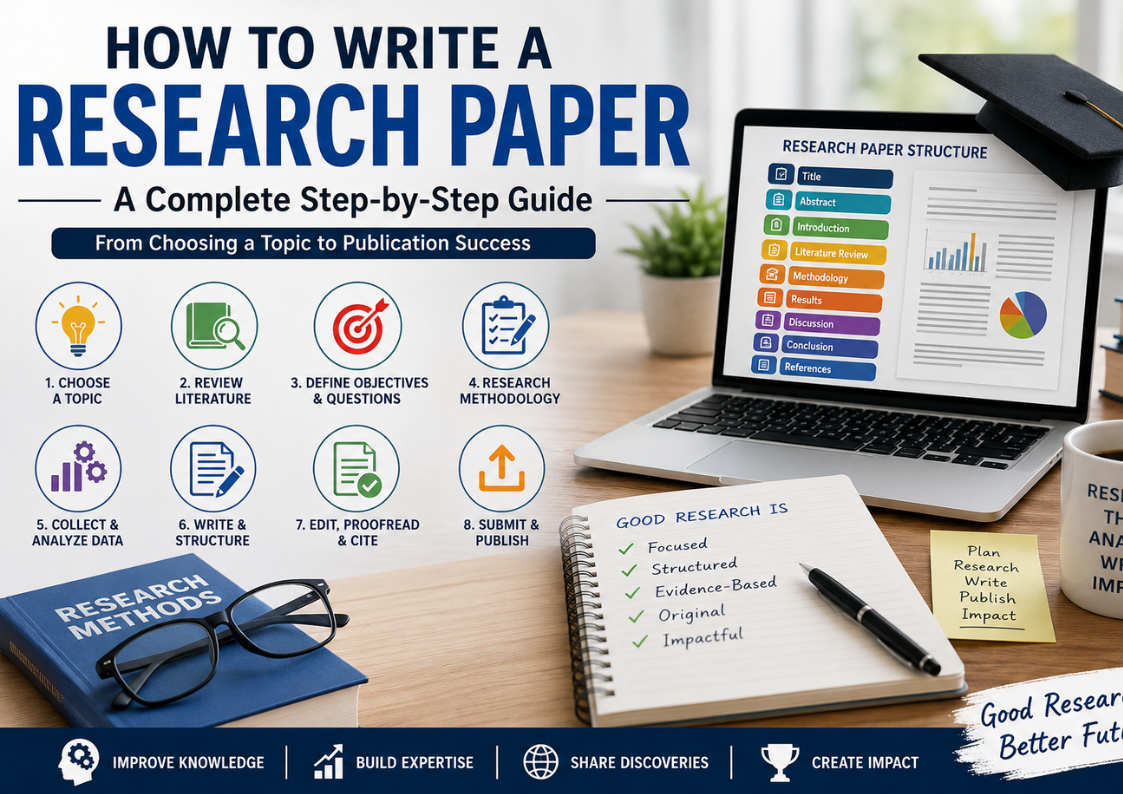
How to Write a Research Paper: A Complete Step-by-Step Guide
By Powerline Research Publication
| August 7, 2026 | 26 min read | Category: Writing Help
Writing a research paper is one of the most valuable academic skills a student or researcher can develop. Whether you are pursuing an undergraduate degree, a master's program, a PhD, or working as a faculty member, research writing plays a central role in sharing knowledge, solving real-world problems, and contributing to academic progress.
For many beginners, however, the process of writing a research paper can seem overwhelming. Choosing a suitable topic, reviewing existing literature, collecting reliable data, organizing ideas, following academic formatting guidelines, and ensuring originality often raise many questions. It is common for new researchers to feel uncertain about where to begin or how to structure their work effectively.
The good news is that research writing is not an innate talent—it is a skill that can be learned and refined with practice. A well-written research paper follows a logical process, where each section builds upon the previous one to communicate findings clearly and convincingly.
This comprehensive guide explains every stage of writing a research paper, from selecting the right topic to preparing the final manuscript for submission. Whether you are writing your first research paper or looking to improve your academic writing skills, the practical advice in this guide will help you produce work that is clear, organized, and academically sound.
Understanding What a Research Paper Is
Before learning how to write a research paper, it is important to understand what a research paper actually represents.
A research paper is a formal academic document that presents original research or critically examines existing knowledge on a specific topic. Unlike essays or opinion articles, research papers rely on evidence, systematic investigation, and credible sources to support their conclusions.
The primary objective of a research paper is to answer a research question or address a particular problem using scientific or scholarly methods. Every claim made within the paper should be supported by data, logical reasoning, or references to previously published research.
Research papers are commonly published in academic journals, presented at conferences, submitted as university assignments, or included in dissertations and theses. Regardless of the purpose, they all share one common goal: contributing meaningful knowledge to a particular field of study.
Why Research Papers Are Important
Research papers play a vital role in advancing education, science, technology, medicine, business, and countless other disciplines. Every major innovation begins with research, and research papers provide the formal means through which discoveries are communicated to the academic community.
Writing research papers helps researchers:
- Develop critical thinking skills.
- Improve analytical abilities.
- Contribute original knowledge to their field.
- Solve practical and theoretical problems.
- Build professional credibility.
- Support evidence-based decision-making.
- Establish expertise in a specialized area.
For students, research papers also strengthen writing, problem-solving, and information evaluation skills that remain valuable throughout their careers.
Step 1: Choose the Right Research Topic
Every successful research paper begins with selecting an appropriate topic. This is arguably one of the most important decisions in the entire research process because the quality of your topic influences every stage that follows.
Many researchers make the mistake of choosing topics that are either too broad or too narrow. A broad topic often leads to superficial discussions, while an overly narrow topic may not provide sufficient literature or data for meaningful analysis.
An effective research topic should be:
- Relevant to your academic discipline.
- Interesting to you as a researcher.
- Supported by sufficient existing literature.
- Specific enough to investigate thoroughly.
- Capable of generating original insights.
For example, instead of selecting a broad topic like Artificial Intelligence, you could narrow your focus to The Impact of Artificial Intelligence on Decision-Making in Healthcare Organizations. A focused topic makes it easier to define objectives, identify relevant studies, and conduct meaningful analysis.
When evaluating a potential topic, ask yourself:
- Does this problem deserve further investigation?
- Has sufficient research already been conducted?
- Can I realistically complete this study with the available time and resources?
- Will my findings contribute something valuable?
Taking time to refine your topic at the beginning will save considerable effort later in the research process.
Step 2: Conduct a Comprehensive Literature Review
Once your topic has been selected, the next step is understanding what other researchers have already discovered.
A literature review involves systematically examining published books, journal articles, conference papers, reports, and other scholarly sources related to your research topic. The goal is not simply to summarize previous studies but to identify patterns, debates, research gaps, and opportunities for further investigation.
Reading existing research serves several important purposes. It helps you understand established theories, learn commonly used research methods, avoid duplicating previous work, and position your own study within the broader academic conversation.
While reviewing literature, pay attention to:
- Frequently cited authors and studies.
- Common research methods.
- Contradictory findings.
- Limitations identified by previous researchers.
- Areas where additional research is needed.
Instead of reading randomly, organize your sources using reference management software or a structured note-taking system. Record important details such as research objectives, methodology, key findings, limitations, and publication information.
As your literature review grows, you will begin to notice unanswered questions and recurring challenges. These research gaps often become the foundation for your own study.
Remember that a good literature review demonstrates critical thinking rather than simply listing summaries of previous articles. Compare studies, discuss similarities and differences, and explain how your research builds upon existing knowledge.
Step 3: Define Your Research Problem and Objectives
After reviewing existing literature, you should have a clearer understanding of what remains unknown about your topic. This is where you define your research problem.
A research problem is the specific issue your study aims to investigate or solve. It should be clear, focused, and supported by evidence from your literature review.
For example, if previous studies have examined the adoption of artificial intelligence in large hospitals but very little research exists on its implementation in rural healthcare facilities, this gap could become your research problem.
Once the problem has been identified, develop clear research objectives. These objectives describe exactly what your study intends to accomplish.
Effective objectives are:
- Specific
- Measurable
- Achievable
- Relevant
- Clearly written
For instance, instead of writing:
"To study artificial intelligence."
A stronger objective would be:
"To evaluate the impact of artificial intelligence on clinical decision-making efficiency in rural healthcare institutions."
Clearly defined objectives provide direction throughout the research process and help maintain focus during data collection and analysis.
Step 4: Formulate Research Questions or Hypotheses
Every research paper is built around one or more central questions.
Research questions guide your investigation and determine the type of data you need to collect. They should arise naturally from the research problem identified during the literature review.
Good research questions are:
- Clear
- Specific
- Researchable
- Relevant
- Logically connected to the study objectives
For quantitative studies, researchers often formulate hypotheses instead of—or alongside—research questions. A hypothesis predicts the expected relationship between variables and can be tested using statistical analysis.
Whether your study uses research questions, hypotheses, or both, they serve as the foundation upon which the remainder of your research paper is constructed.
Step 5: Choose the Right Research Methodology
The methodology explains how your research was conducted. It is one of the most important sections of a research paper because it allows readers to understand your research process and evaluate the reliability of your findings.
Your methodology should align with your research objectives and the type of questions you want to answer.
Generally, research methodologies fall into three categories:
Quantitative Research
Quantitative research focuses on numerical data and statistical analysis. It is commonly used when researchers want to measure relationships, compare groups, or test hypotheses.
Examples include:
- Surveys
- Experiments
- Statistical modeling
- Structured questionnaires
Quantitative research is widely used in fields such as engineering, medicine, economics, psychology, and business.
Qualitative Research
Qualitative research seeks to understand experiences, opinions, behaviors, or social phenomena in greater depth.
Common qualitative methods include:
- Interviews
- Focus groups
- Case studies
- Observations
- Content analysis
Instead of producing numerical results, qualitative research generates rich descriptions and thematic insights.
Mixed Methods Research
Some studies combine both quantitative and qualitative approaches to provide a more comprehensive understanding of a research problem.
For example, a researcher studying online education may collect survey data from students while also conducting interviews with faculty members.
Using multiple methods often strengthens research findings because different types of evidence support the same conclusion.
Step 6: Design Your Research
Research design refers to the overall strategy used to answer your research questions.
It provides a framework for collecting, measuring, and analyzing data while ensuring that the study remains systematic and objective.
Some common research designs include:
Descriptive Research
Descriptive studies explain what exists without attempting to determine cause-and-effect relationships.
Example:
A survey examining students' satisfaction with online learning.
Experimental Research
Experimental research investigates whether one variable influences another by controlling experimental conditions.
Example:
Testing whether a new teaching method improves examination scores.
Correlational Research
Correlation studies examine whether two variables are related without claiming one causes the other.
Example:
Studying the relationship between social media usage and academic performance.
Case Study Research
Case studies provide an in-depth examination of a single organization, event, community, or individual.
They are especially common in business, education, healthcare, and social sciences.
Selecting the correct research design improves the credibility and accuracy of your study.
Step 7: Collect Reliable Data
Data collection forms the evidence upon which your research conclusions are based. Poor-quality data inevitably leads to weak conclusions, regardless of how well the paper is written.
Researchers generally use two types of data.
Primary Data
Primary data is collected directly by the researcher.
Examples include:
- Surveys
- Interviews
- Questionnaires
- Laboratory experiments
- Field observations
Primary data allows researchers to answer highly specific research questions but often requires significant time and resources.
Secondary Data
Secondary data has already been collected by other organizations or researchers.
Examples include:
- Published journal articles
- Government reports
- Census data
- Industry reports
- Institutional databases
Secondary data is often more accessible and cost-effective but may not perfectly match the objectives of your study.
Step 8: Select an Appropriate Sampling Method
In many studies, it is impossible to collect data from every individual within a population. Instead, researchers select a representative sample.
Choosing the correct sampling technique helps reduce bias and improve the validity of your findings.
Probability Sampling
Each member of the population has a known chance of being selected.
Examples include:
- Simple random sampling
- Stratified sampling
- Cluster sampling
- Systematic sampling
Probability sampling generally produces more reliable and representative results.
Non-Probability Sampling
Selection depends on convenience or researcher judgment.
Examples include:
- Convenience sampling
- Purposive sampling
- Snowball sampling
- Quota sampling
Although commonly used in qualitative research, non-probability sampling may reduce the generalizability of findings.
Step 9: Follow Ethical Research Practices
Ethics play a fundamental role in academic research. Researchers have a responsibility to protect participants, maintain honesty, and ensure transparency throughout the research process.
Ethical research includes:
- Obtaining informed consent from participants.
- Protecting participant confidentiality.
- Reporting findings honestly.
- Avoiding plagiarism.
- Declaring conflicts of interest.
- Respecting copyright and intellectual property.
Research misconduct can seriously damage academic credibility and may lead to manuscript rejection or institutional disciplinary action.
Always follow your institution's ethical guidelines before beginning data collection.
Step 10: Analyze Your Data Carefully
After collecting your data, the next step is transforming it into meaningful findings.
The analysis process depends on your chosen methodology.
Quantitative Analysis
Numerical data is typically analyzed using statistical techniques.
Researchers may use software such as:
- SPSS
- R
- Python
- STATA
- Excel
Common analyses include:
- Descriptive statistics
- Correlation analysis
- Regression analysis
- T-tests
- ANOVA
The goal is to identify meaningful patterns that answer your research questions.
Qualitative Analysis
Qualitative data requires interpretation rather than statistical calculation.
Researchers often:
- Identify recurring themes.
- Categorize responses.
- Interpret participant experiences.
- Compare viewpoints.
Software such as NVivo or ATLAS.ti can assist with organizing qualitative data, although manual analysis is also common.
Step 11: Create a Logical Outline Before Writing
One mistake many researchers make is starting to write without a clear structure.
Creating an outline first helps organize ideas and reduces the chances of overlooking important information.
A typical research paper follows this structure:
- Title
- Abstract
- Keywords
- Introduction
- Literature Review
- Research Methodology
- Results
- Discussion
- Conclusion
- References
- Appendices (if applicable)
Think of the outline as the blueprint for your paper. It helps maintain logical flow from beginning to end.
Step 12: Write a Clear and Informative Title
The title is the first element readers encounter. It should accurately represent your research without being unnecessarily long or vague.
A strong title should:
- Clearly describe the topic.
- Include important keywords.
- Avoid unnecessary abbreviations.
- Reflect the main focus of the study.
Compare these examples:
Weak title:
"Technology in Education"
Improved title:
"The Impact of Artificial Intelligence on Student Learning Outcomes in Higher Education"
A precise title improves discoverability in academic databases and search engines.
Step 13: Write an Effective Abstract
Although the abstract appears at the beginning of the paper, it is usually written after completing the entire manuscript.
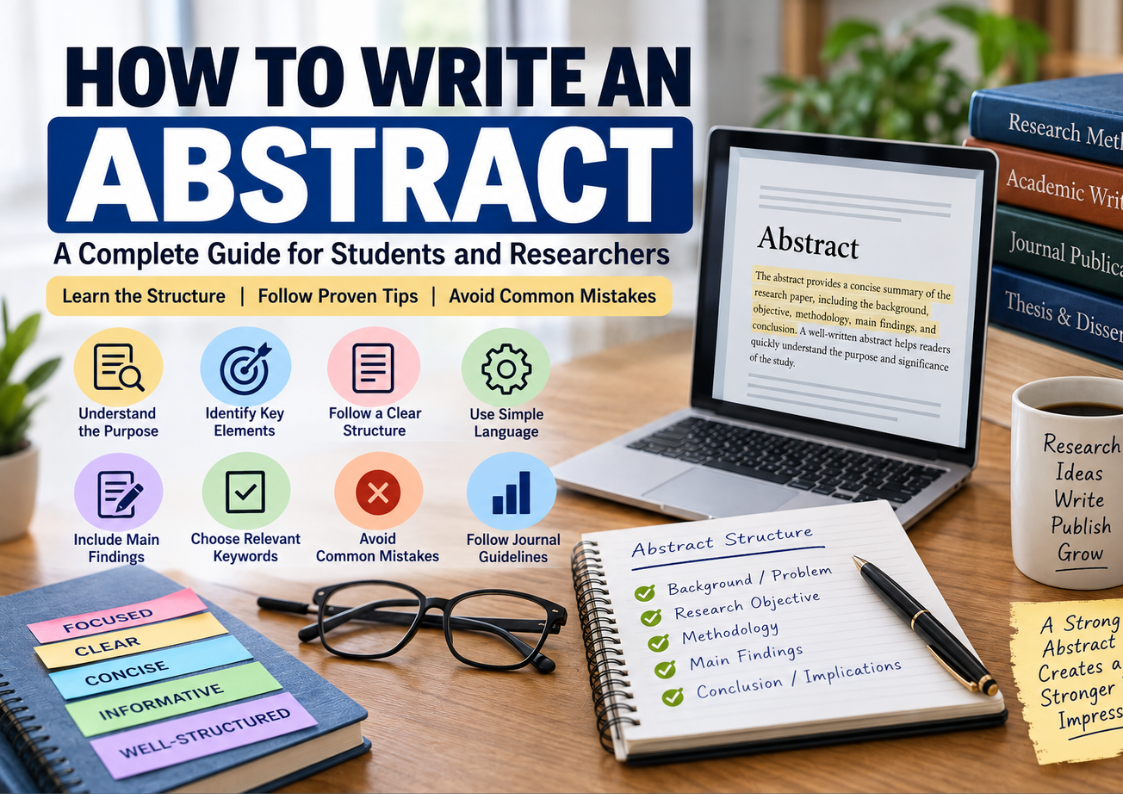
The abstract provides a concise overview of the study.
It should briefly explain:
- The research problem.
- Research objectives.
- Methodology.
- Key findings.
- Main conclusion.
An effective abstract enables readers to determine quickly whether the paper is relevant to their interests.
Keep it concise, informative, and free from unnecessary citations.
Step 14: Choose Relevant Keywords
Keywords improve the discoverability of your research in academic databases and search engines.
Select keywords that accurately represent your study.
Good keywords should:
- Match commonly searched academic terms.
- Reflect your research topic.
- Avoid overly broad expressions.
- Include important concepts discussed in the paper.
For example, a study on sustainable tourism might include:
- Sustainable tourism
- Ecotourism
- Destination management
- Environmental sustainability
- Tourism development
Using relevant keywords increases the likelihood that other researchers will discover your work.
Step 15: Write a Strong Introduction
The introduction establishes the context for your research and prepares readers for the rest of the paper.
A well-written introduction typically includes:
- Background information.
- Importance of the topic.
- Existing knowledge.
- Research gap.
- Research problem.
- Objectives.
- Research questions or hypotheses.
- Overview of the paper.
Rather than overwhelming readers with excessive details, gradually narrow the discussion toward the specific problem your study addresses.
By the end of the introduction, readers should understand why the research was conducted and what they can expect from the remainder of the paper.
Practical Tips Before Moving Forward
As you begin writing your manuscript, remember these practical recommendations:
- Write clearly rather than trying to sound overly technical.
- Use credible and up-to-date references.
- Maintain consistency in terminology throughout the paper.
- Support every important claim with evidence.
- Keep paragraphs focused on one central idea.
- Follow the formatting guidelines required by your target journal or institution.
A well-organized paper is much easier for reviewers and readers to understand than one filled with unnecessary complexity.
Step 16: Write a Comprehensive Literature Review
The literature review is much more than a summary of previous studies. It demonstrates your understanding of existing research, identifies knowledge gaps, and explains how your study contributes to the field.
Many beginner researchers make the mistake of reviewing one article after another without creating connections between them. A strong literature review compares findings, evaluates different perspectives, and builds a logical foundation for your research.
When writing this section, organize studies by themes, concepts, methodologies, or chronological development rather than discussing each source separately.
For example, if your research focuses on artificial intelligence in healthcare, you might organize the literature into categories such as:
- AI applications in diagnosis
- Clinical decision support systems
- Ethical concerns
- Adoption challenges
- Future research opportunities
This thematic approach helps readers understand the evolution of the research area instead of reading disconnected summaries.
How to Critically Analyze Previous Studies
A literature review should answer questions such as:
- What have previous researchers discovered?
- Where do researchers agree?
- Where do their findings differ?
- What limitations exist?
- What research gaps remain?
Instead of writing:
"Smith (2022) studied online learning."
You should explain:
"Smith (2022) found that interactive digital learning platforms significantly improved student engagement. However, the study focused only on urban universities, leaving rural educational institutions largely unexplored."
This type of analysis demonstrates critical thinking and naturally leads to your own research.
Step 17: Describe Your Research Methodology Clearly
Although you planned your methodology earlier, this section explains it in sufficient detail so that another researcher could replicate your study.
Your methodology should typically include:
Research Approach
State whether your study uses:
- Quantitative research
- Qualitative research
- Mixed methods
Explain why this approach is appropriate for your objectives.
Research Design
Describe your research design and explain why it best addresses your research questions.
Examples include:
- Experimental
- Descriptive
- Exploratory
- Correlational
- Case study
Population and Sample
Clearly identify:
- Target population
- Sample size
- Sampling technique
- Participant characteristics (if applicable)
Readers should understand who participated and how participants were selected.
Data Collection
Describe:
- Instruments used
- Survey design
- Interview procedures
- Experimental setup
- Observation methods
Include sufficient detail without becoming repetitive.
Data Analysis
Explain how the collected data was analyzed.
For quantitative studies, mention statistical techniques.
For qualitative research, explain coding procedures or thematic analysis methods.
The methodology should be objective, factual, and free from interpretation.
Step 18: Present Your Results Objectively
The results section reports your findings without explaining why they occurred.
Many researchers mistakenly combine results and discussion into one section. Unless required by the journal, these sections should remain separate.
Present only the findings that directly relate to your research objectives.
Use:
- Tables
- Graphs
- Charts
- Figures
when they improve clarity.
Avoid repeating every value shown in a table. Instead, summarize the most important findings.
For example:
"The analysis revealed that 78% of respondents preferred hybrid learning over traditional classroom instruction."
This communicates the key finding efficiently.
Present Data Clearly
When presenting numerical results:
- Maintain consistent decimal places.
- Number all tables and figures.
- Provide descriptive titles.
- Reference each table within the text.
- Explain unusual or unexpected findings.
Good presentation improves readability and helps reviewers evaluate your work more efficiently.
Step 19: Write a Meaningful Discussion
The discussion section answers one important question:
What do the findings actually mean?
This is where you interpret your results rather than simply reporting them.
A strong discussion should:
- Explain major findings.
- Compare results with previous studies.
- Discuss theoretical implications.
- Highlight practical applications.
- Explain unexpected outcomes.
- Address study limitations.
For example:
"The findings support previous studies demonstrating the effectiveness of artificial intelligence in improving diagnostic accuracy. However, unlike earlier research conducted in developed healthcare systems, this study identified infrastructure limitations as a major barrier in rural hospitals."
Such comparisons show that your research contributes to existing academic knowledge.
Discuss the Significance of Your Findings
Readers should understand why your results matter.
Consider discussing:
- Educational implications
- Policy implications
- Industrial applications
- Clinical relevance
- Environmental significance
- Future technological developments
A discussion should move beyond numbers and explain the broader importance of the research.
Step 20: Acknowledge Research Limitations
Every research study has limitations.
Acknowledging them demonstrates honesty rather than weakness.
Possible limitations include:
- Small sample size
- Limited geographical coverage
- Time constraints
- Restricted access to data
- Resource limitations
- Methodological constraints
Example:
"The study was conducted within one metropolitan region, which may limit the generalizability of the findings to other geographical contexts."
Reviewers appreciate transparency.
Step 21: Provide Practical Recommendations
Recommendations should arise naturally from your findings.
Suggestions may be directed toward:
- Researchers
- Policymakers
- Educational institutions
- Healthcare organizations
- Businesses
- Government agencies
Avoid making recommendations unsupported by your data.
Each recommendation should logically follow from your research results.
Step 22: Use Tables and Figures Effectively
Visual elements often communicate complex information more efficiently than paragraphs.
Useful visuals include:
- Tables
- Flowcharts
- Graphs
- Conceptual frameworks
- Statistical charts
- Process diagrams
However, visuals should complement—not replace—the written discussion.
Every figure should include:
- Figure number
- Descriptive title
- Source (if applicable)
Likewise, every table should be properly numbered and referenced within the text.
Step 23: Follow a Consistent Citation Style
Academic writing requires proper acknowledgment of previous work.
Different disciplines use different citation styles.
Common styles include:
APA Style
Frequently used in:
- Psychology
- Education
- Business
- Social Sciences
MLA Style
Common in:
- Literature
- Humanities
- Language studies
Chicago Style
Often used in:
- History
- Arts
- Cultural studies
IEEE Style
Widely used in:
- Engineering
- Computer Science
- Electronics
Always follow the citation style specified by your university or target journal.
Mixing citation styles creates inconsistency and reflects poor academic practice.
Step 24: Avoid Plagiarism
Plagiarism remains one of the most serious ethical violations in academic publishing.
It occurs when someone presents another person's ideas, words, or work without proper acknowledgment.
Common forms include:
- Copying text directly.
- Improper paraphrasing.
- Missing citations.
- Duplicate publication.
- Self-plagiarism.
To avoid plagiarism:
- Write in your own words.
- Cite all borrowed ideas.
- Use quotation marks for direct quotations.
- Maintain accurate reference lists.
- Review originality before submission.
Remember that plagiarism includes ideas as well as exact wording.
Step 25: Revise Your First Draft
Very few excellent research papers are written perfectly on the first attempt.
Revision is where good papers become excellent ones.
Review your manuscript for:
- Logical flow
- Paragraph structure
- Grammar
- Spelling
- Consistency
- Clarity
- Citation accuracy
- Formatting
Reading your paper aloud often helps identify awkward sentences and unclear transitions.
Whenever possible, ask a colleague or supervisor to review your manuscript before submission.
Fresh perspectives frequently reveal issues the original author overlooks.
Common Mistakes That Lead to Journal Rejection
Many manuscripts are rejected because of avoidable mistakes rather than poor research.
Some of the most common reasons include:
Weak Research Questions
Unclear objectives confuse reviewers from the beginning.
Poor Literature Review
Failing to identify research gaps weakens the justification for the study.
Inappropriate Methodology
Using unsuitable research methods reduces confidence in the findings.
Unsupported Conclusions
Conclusions must be based on evidence presented in the paper.
Language Problems
Poor grammar and unclear writing make even strong research difficult to understand.
Inconsistent Referencing
Missing citations and formatting errors suggest carelessness.
Ignoring Journal Guidelines
Every journal has specific formatting and submission requirements.
Failure to follow these instructions often results in immediate rejection before peer review.
Tips for Writing Like an Experienced Researcher
As your academic writing skills improve, focus on writing that is:
- Clear instead of complicated.
- Logical instead of repetitive.
- Evidence-based instead of opinion-based.
- Precise instead of vague.
- Concise without sacrificing important details.
Remember that reviewers are interested in understanding your research—not decoding unnecessarily complex language.
The best academic writing communicates sophisticated ideas with clarity and confidence.
Step 26: Write a Strong Conclusion
The conclusion is the final opportunity to leave a lasting impression on your readers. It should summarize your study without simply repeating information from previous sections.
A strong conclusion should:
- Restate the purpose of the research.
- Summarize the key findings.
- Explain the significance of the results.
- Highlight the contribution to existing knowledge.
- Suggest directions for future research.
Rather than introducing new information, focus on bringing the study together in a logical and meaningful way.
For example, instead of writing:
"This research discussed artificial intelligence."
You could write:
"This study demonstrated that artificial intelligence has the potential to improve organizational decision-making by increasing efficiency, reducing human error, and supporting evidence-based management practices. These findings contribute to the growing body of research on AI adoption and provide valuable insights for future organizational strategies."
A well-written conclusion reinforces the value of your work and encourages further discussion within the academic community.
Step 27: Prepare a Complete Reference List
Every source cited in your paper must appear in the reference list, and every reference listed should be cited within the text.
Maintaining consistency is essential.
Depending on your discipline, your journal may require citation styles such as:
- APA
- MLA
- Chicago
- IEEE
- Harvard
- Vancouver
Reference management software can simplify this process by automatically formatting citations and bibliographies.
Popular tools include:
- Zotero
- Mendeley
- EndNote
- RefWorks
Before submission, carefully verify:
- Author names
- Publication years
- Article titles
- Journal names
- Volume and issue numbers
- Page ranges
- Digital Object Identifiers (DOIs), where available
Accurate references demonstrate professionalism and help readers locate your sources.
Step 28: Proofread Your Manuscript Carefully
Proofreading is one of the most overlooked stages of research writing. Even well-designed studies can appear unprofessional if the manuscript contains spelling mistakes, inconsistent formatting, or grammatical errors.
During proofreading, check for:
- Grammar and punctuation
- Sentence clarity
- Consistent terminology
- Typographical errors
- Table and figure numbering
- Heading consistency
- Citation accuracy
- Formatting requirements
It is often helpful to take a short break before proofreading. Returning to your paper with fresh eyes makes it easier to identify mistakes.
Reading the manuscript aloud can also reveal awkward sentence structures and repetitive wording.
Step 29: Check Originality Before Submission
Academic integrity is a fundamental principle of research publishing. Before submitting your manuscript, review it carefully to ensure that all borrowed ideas, data, and quotations are properly cited.
Many universities and journals use similarity detection tools to evaluate submitted manuscripts. While some level of similarity is expected due to references, standard terminology, and properly cited quotations, excessive overlap can delay or prevent publication.
To improve originality:
- Paraphrase information in your own words.
- Cite all sources accurately.
- Avoid copying text from previous publications.
- Ensure your interpretations and discussions are original.
Remember that originality is not only about avoiding copied text—it is also about contributing new knowledge or perspectives to your field.
Step 30: Select the Right Journal
Choosing the appropriate journal is just as important as writing a high-quality paper.
A journal should match your research in terms of:
- Subject area
- Audience
- Scope
- Publication standards
Before submitting, review the journal's:
- Aims and scope
- Author guidelines
- Formatting requirements
- Peer-review process
- Publication ethics
- Submission instructions
Submitting to an unsuitable journal often leads to immediate rejection, even when the research itself is strong.
Take time to evaluate whether your paper aligns with the journal's focus before submitting.
Step 31: Understand the Peer Review Process
Most reputable academic journals use peer review to evaluate submitted manuscripts.
During this process, independent experts assess your paper based on:
- Originality
- Methodology
- Scientific accuracy
- Clarity
- Contribution to the field
- Ethical standards
The reviewers may recommend:
- Acceptance
- Minor revisions
- Major revisions
- Rejection
Receiving revision requests is completely normal. Even experienced researchers rarely receive immediate acceptance without revisions.
Treat reviewer feedback as an opportunity to strengthen your manuscript rather than as criticism.
Step 32: Respond Professionally to Reviewer Comments
If reviewers request revisions, prepare a detailed response explaining how each comment has been addressed.
A professional response should:
- Thank the reviewers for their feedback.
- Address every comment individually.
- Explain all revisions clearly.
- Politely justify any suggestions that could not be implemented.
Maintaining a respectful and constructive tone improves communication with editors and reviewers.
Step 33: Keep Improving Your Research Writing Skills
Research writing is a continuous learning process.
Every paper teaches valuable lessons about:
- Academic writing
- Research design
- Data analysis
- Scientific communication
- Publication standards
The most successful researchers improve gradually through reading, writing, reviewing, and revising.
Developing strong research writing skills requires patience, consistency, and a willingness to accept constructive feedback.
Research Paper Writing Checklist
Before submitting your manuscript, use the following checklist:
✔ The research topic is clear and relevant.
✔ The research problem is well defined.
✔ Objectives and research questions are aligned.
✔ The literature review identifies existing knowledge and research gaps.
✔ The methodology is explained clearly.
✔ Data collection methods are appropriate.
✔ Results are presented accurately.
✔ The discussion interprets the findings effectively.
✔ Conclusions are supported by evidence.
✔ References follow the required citation style.
✔ Grammar, spelling, and formatting have been reviewed.
✔ Tables and figures are numbered correctly.
✔ All citations are complete and accurate.
✔ Ethical guidelines have been followed.
✔ The manuscript complies with the target journal's submission requirements.
Using a checklist reduces the likelihood of avoidable mistakes and improves the overall quality of your submission.
Frequently Asked Questions
How long should a research paper be?
The length depends on your institution, discipline, and target journal. Some papers are fewer than 3,000 words, while others exceed 10,000 words. Always follow the specific guidelines provided by your university or journal.
How many references should a research paper include?
There is no fixed number. A research paper should include enough relevant and credible sources to support its arguments and demonstrate a thorough understanding of the topic. Quality is more important than quantity.
Can I use AI tools while writing a research paper?
AI tools can assist with brainstorming, grammar improvement, language refinement, and organizing ideas. However, researchers remain responsible for the accuracy, originality, and integrity of the final manuscript. Always follow your institution's and journal's policies regarding AI-assisted writing.
How can I improve my academic writing?
Regular reading of high-quality journal articles, consistent writing practice, constructive feedback from supervisors, and careful revision are among the most effective ways to improve academic writing skills.
Is publishing in a high-impact journal always necessary?
High-impact journals offer excellent visibility, but the best choice is a reputable journal that aligns closely with your research area and intended audience. Relevance and quality should guide your decision.
Common Habits of Successful Researchers
Experienced researchers often share several productive habits:
- They read extensively before beginning a study.
- They maintain detailed research notes.
- They organize references from the start.
- They revise their manuscripts multiple times.
- They seek feedback before submission.
- They stay informed about developments in their field.
- They follow ethical research practices consistently.
- They view revisions as part of the publication process rather than obstacles.
These habits contribute not only to stronger papers but also to long-term academic growth.
Final Thoughts
Writing a research paper is a journey that combines curiosity, critical thinking, and disciplined effort. While the process may seem challenging at first, every stage—from selecting a meaningful research topic to submitting the final manuscript—plays a vital role in producing credible and impactful academic work.
A successful research paper is not defined by complicated language or lengthy discussions. Instead, it reflects a clear research question, a sound methodology, reliable evidence, thoughtful analysis, and well-supported conclusions. When these elements come together, your research becomes more than an academic requirement—it becomes a meaningful contribution to your field of study.
Remember that even experienced researchers continue learning with every publication. Rejections, revisions, and reviewer feedback are natural parts of the scholarly publishing process and often lead to stronger, more refined research. Rather than aiming for perfection in your first draft, focus on continuous improvement, careful revision, and adherence to academic integrity.
Ultimately, the purpose of research is to expand knowledge, encourage informed discussion, and solve real-world problems. By following a structured writing process, maintaining ethical standards, and communicating your findings clearly, you can produce research papers that not only meet academic expectations but also make a lasting impact on the wider research community.
Whether you are preparing your first university assignment or submitting a manuscript to an international journal, the principles outlined in this guide will help you approach research writing with confidence, professionalism, and a commitment to excellence.
📧 Subscribe to Newsletter




No comments yet. Be the first!