
Writing a high-quality research article is a skill every scholar must master. Whether you are pursuing your PhD, working on funded projects, or aiming for publication in Scopus, Web of Science, ABDC, or UGC Care indexed journals, the way you present your research determines its impact.
At Powerline Research Publication, we assist scholars in transforming their manuscripts into well-structured, publication-ready research articles. In this guide, we’ll walk you through the step-by-step process of writing a research article that meets global academic standards.
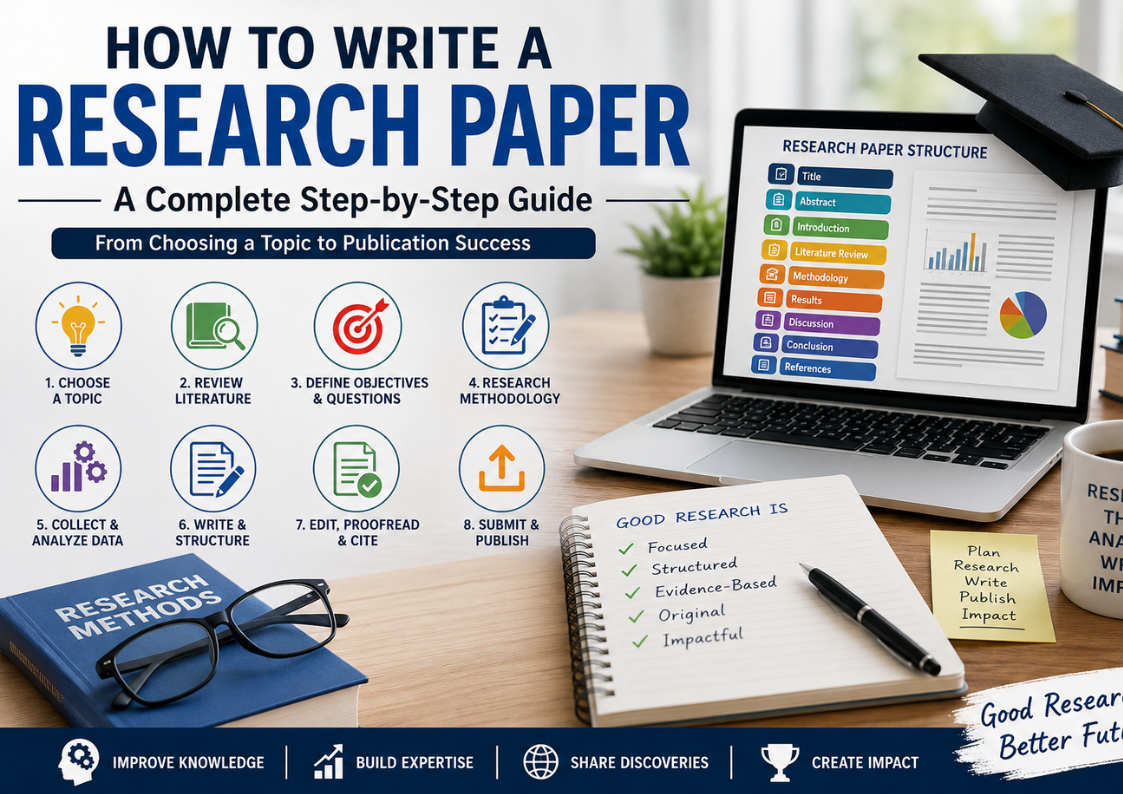
Step 1: Choosing the Right Research Topic
Your research journey begins with selecting a focused, original, and relevant topic.
✔ Ensure the topic addresses a research gap.
✔ Choose a subject aligned with current trends in your discipline.
✔ Make sure enough literature and data sources are available.
Example: Instead of writing “Impact of Technology on Education,” narrow it down to “Effect of AI-Powered Learning Platforms on Higher Education in India.
Step 2: Conducting a Comprehensive Literature Review
A strong literature review builds the foundation of your research article.
-
Use databases like Scopus, Web of Science, PubMed, and Google Scholar.
-
Identify gaps in previous research.
-
Summarize key studies and highlight their limitations.
Pro Tip: Tools like Zotero, Mendeley, and EndNote can help organize citations effectively.
Step 3: Designing the Research Methodology
The methodology section must clearly explain how the study was conducted.
-
Define your research design (qualitative, quantitative, or mixed).
-
Explain data collection methods (survey, experiment, interview, secondary data).
-
Mention the tools, techniques, and software used (SPSS, R, Python, MATLAB).
A transparent methodology enhances credibility and reproducibility of your research.
Step 4: Data Collection and Analysis
The heart of any research lies in data collection and interpretation.
-
Ensure validity and reliability of data.
-
Use statistical tests (t-test, regression, ANOVA, correlation) or qualitative coding.
-
Present findings using tables, graphs, and charts for clarity.
Journals prefer articles that demonstrate strong analytical rigor supported by evidence.
Step 5: Writing the Research Article Structure
A standard research article typically follows the IMRAD Format:




No comments yet. Be the first!