
Can AI Write a Complete Research Paper Without Plagiarism?
Artificial Intelligence has rapidly transformed academic writing. From grammar correction to literature summarization, AI tools are now widely used by students, researchers, and institutions. As we move into 2026, one critical question dominates academic discussions: Can AI write a complete research paper without plagiarism?
The answer is not a simple yes or no. While AI has become a powerful support tool, its role in producing a fully original, ethically acceptable research paper remains limited. This article provides a balanced and professional evaluation of AI’s capabilities, risks, and responsible use in research writing.
Understanding How AI Writes Research Content
AI writing tools work by analyzing vast datasets of existing text and predicting language patterns. They do not “think,” conduct experiments, or generate new knowledge. Instead, they:
-
Rephrase existing ideas
-
Summarize published literature
-
Generate structured academic language
Although modern AI can produce fluent and coherent text, it does not independently verify facts or originality unless guided carefully by a human author.
Can AI Produce Plagiarism-Free Content?
Technically, AI can generate text that passes plagiarism detection software. However, plagiarism in academic research is not limited to copied sentences. It also includes:
-
Reproducing ideas without proper citation
-
Paraphrasing established theories without attribution
-
Presenting AI-generated interpretations as original research
In 2026, many universities and journals evaluate conceptual originality, not just similarity scores. This means AI-generated content can still be ethically problematic even if plagiarism tools show low similarity.
Why AI Cannot Fully Replace a Human Researcher
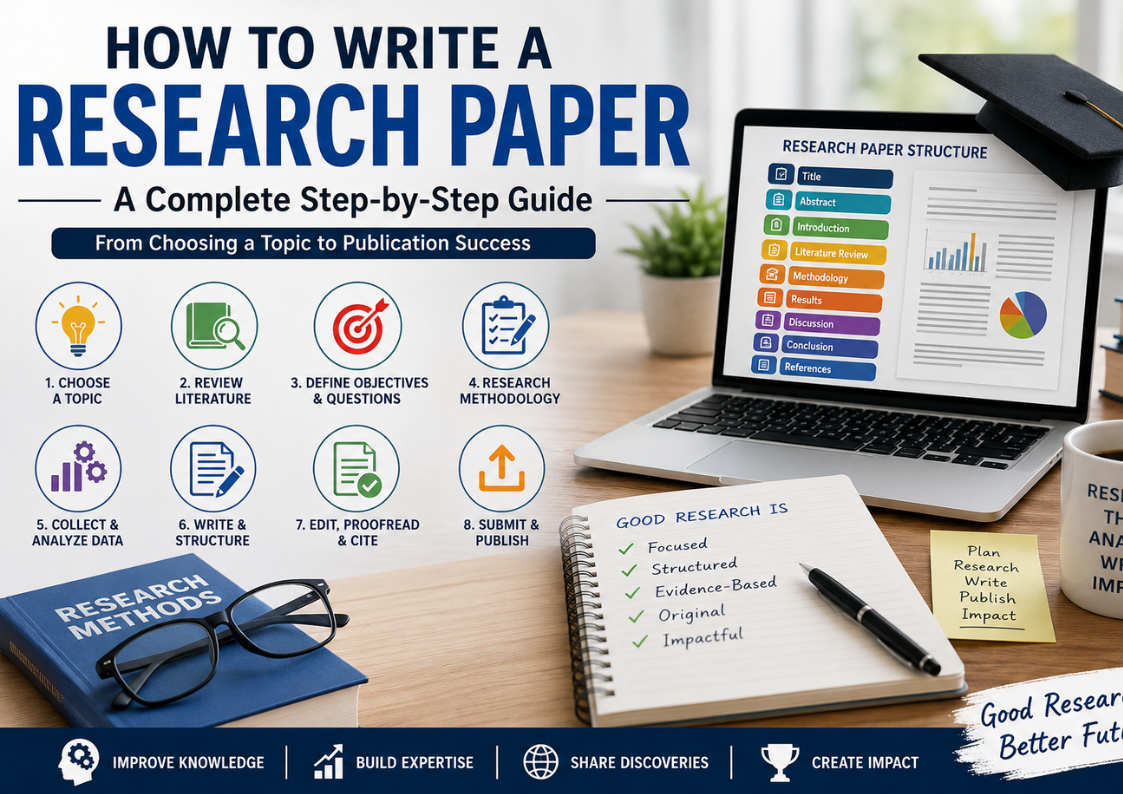
A complete research paper requires more than language generation. It involves:
-
Identifying a genuine research gap
-
Designing methodology
-
Collecting and analyzing data
-
Interpreting results critically
-
Drawing context-based conclusions
AI cannot conduct experiments, surveys, or fieldwork. It also lacks the ability to understand disciplinary nuances, ethical approvals, or real-world implications. Therefore, AI cannot independently author a valid research paper in the true academic sense.
Major Risks of Using AI for Complete Paper Writing
🚩 1. Lack of Original Contribution
AI cannot generate new scientific findings. Journals increasingly reject papers that lack original contribution, even if language quality is high.
🚩 2. Hallucinated References
AI may generate citations that do not exist or misattribute authors, which is a serious academic violation.
🚩 3. Violation of Journal Policies
Many journals in 2026 require authors to declare AI usage. Undisclosed AI-generated manuscripts may lead to rejection or retraction.
🚩 4. Ethical and Authorship Concerns
Authorship implies intellectual responsibility. AI cannot take responsibility for errors, data integrity, or ethical compliance.


No comments yet. Be the first!