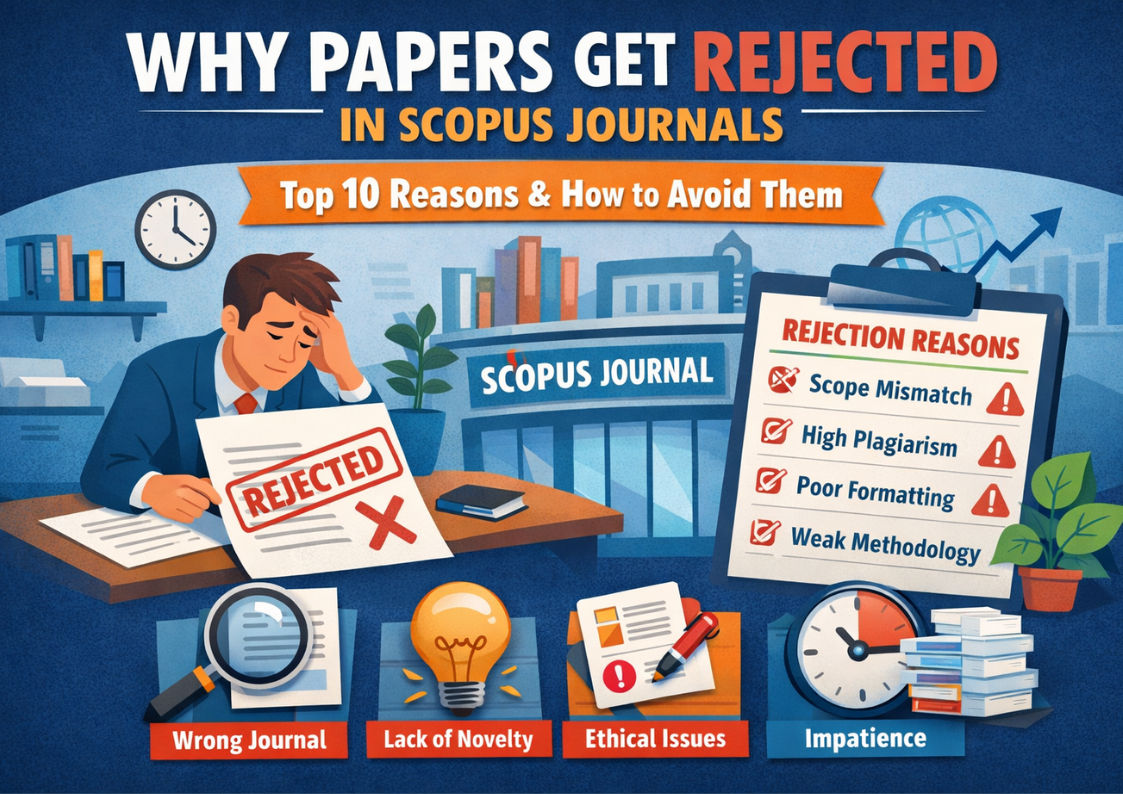
Publishing in a Scopus indexed journal is a major milestone for researchers, PhD scholars, and academicians. It enhances credibility, strengthens academic profiles, and plays a critical role in promotions and career advancement.
However, many authors face rejection — sometimes repeatedly — without fully understanding why.
If your paper has been rejected by a Scopus journal, you are not alone. Rejection is a common part of academic publishing. The key difference between successful researchers and struggling ones is not intelligence — it is awareness of common mistakes and the ability to correct them.
In this detailed guide, we will explore the top 10 reasons why papers get rejected in Scopus journals and how you can avoid them.
1. Submitting to the Wrong Journal
One of the most common reasons for rejection is scope mismatch.
Every Scopus journal has a clearly defined aim and scope. If your research topic does not align with the journal’s focus area, editors may reject it without even sending it for peer review.
For example, submitting a marketing research paper to a journal focused on environmental engineering will almost always lead to desk rejection.
How to Avoid This:
-
Carefully read the journal’s scope and recent published articles.
-
Analyze whether your study genuinely fits the subject area.
-
Do not choose journals based only on quartile (Q1, Q2, etc.).
Proper journal selection significantly increases acceptance probability.
2. Weak Research Contribution
Scopus journals prioritize originality and contribution to existing literature.
If your paper:
-
Repeats existing studies
-
Offers minimal innovation
-
Lacks theoretical or practical advancement
It may be rejected for lacking novelty.
Editors often ask:
“What new value does this study add?”
If that question is not clearly answered, rejection becomes likely.
How to Avoid This:
-
Clearly define your research gap.
-
Explain how your study differs from previous research.
-
Highlight theoretical, methodological, or practical contributions.
Originality is one of the strongest acceptance factors.
3. Poor Literature Review
A superficial literature review signals weak academic foundation.
Common problems include:
-
Outdated references
-
Over-reliance on non-indexed sources
-
Lack of critical analysis
-
No clear research gap identification
Scopus journals expect a structured and analytical literature review, not just a summary of previous studies.
How to Avoid This:
-
Include recent studies (last 5–7 years).
-
Use indexed and reputable sources.
-
Critically compare findings instead of merely describing them.
-
Clearly identify research gaps.
A strong literature review builds trust in your work.
4. High Plagiarism Percentage
Plagiarism remains a serious issue in academic publishing.
Most Scopus journals use plagiarism detection tools. Even unintentional similarity from poorly paraphrased content can lead to rejection.
Generally, journals expect:
-
Overall similarity below 10–15%
-
Minimal similarity in methodology and literature sections
-
No copied conclusions or discussions
How to Avoid This:
-
Write in your own words.
-
Properly cite all sources.
-
Avoid copying structure from other papers.
-
Use plagiarism checking tools before submission.
Ethical writing is non-negotiable in academic publishing.
5. Weak Methodology
A poorly designed research methodology often leads to rejection.
Common issues include:
-
Small or unjustified sample size
-
Incorrect statistical techniques
-
Lack of research design clarity
-
No explanation of data collection procedures
Reviewers examine whether your methodology can genuinely answer your research questions.
How to Avoid This:
-
Justify your sample size.
-
Clearly describe research design.
-
Use appropriate statistical tools.




No comments yet. Be the first!