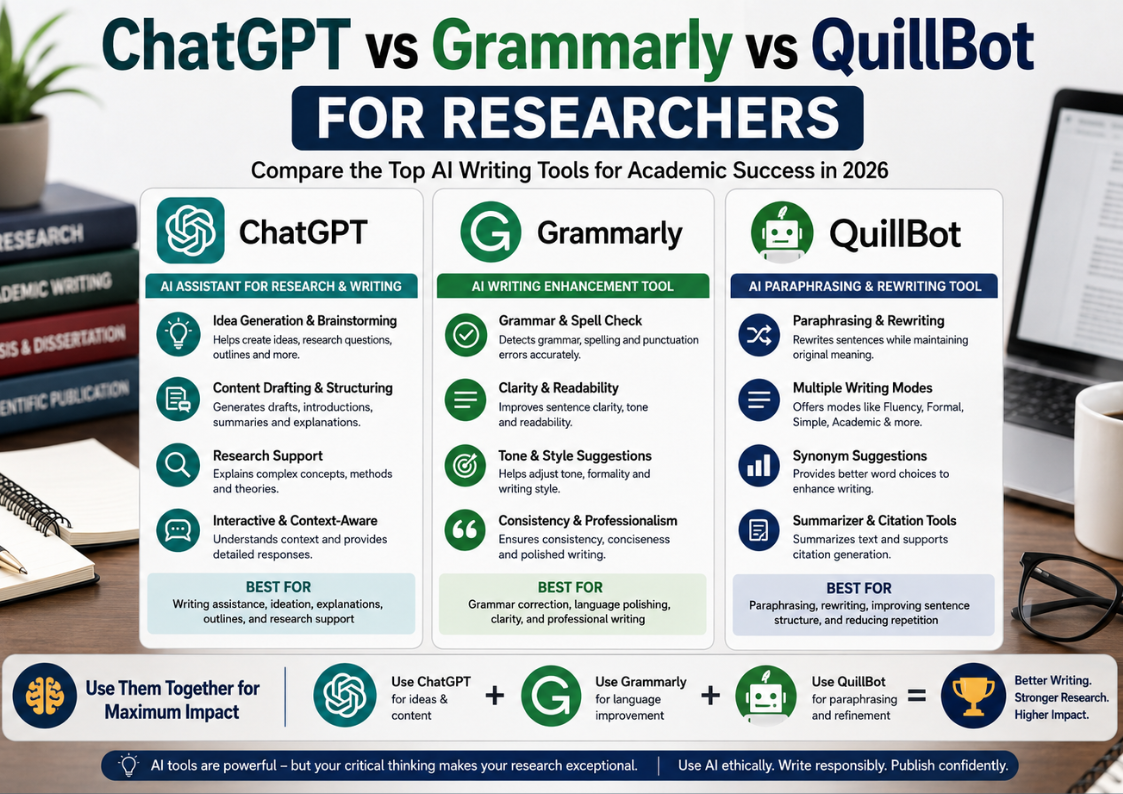
Artificial intelligence tools have transformed academic writing in recent years. Researchers, PhD scholars, and students now use AI-powered platforms not only for grammar correction but also for paraphrasing, content refinement, idea generation, and research assistance. Among the most widely used tools in academic writing today are ChatGPT, Grammarly, and QuillBot.
As academic competition increases in 2026, researchers are constantly looking for ways to improve writing quality, save time, and reduce language-related challenges. However, with multiple AI writing tools available, many researchers struggle to decide which platform is most suitable for their academic needs.
Some researchers prefer ChatGPT because of its ability to generate explanations and assist with writing ideas. Others rely on Grammarly for grammar correction and professional language polishing. Meanwhile, QuillBot has gained popularity for paraphrasing and sentence restructuring.
The reality is that these tools are designed for different purposes, and understanding their strengths and limitations is essential before integrating them into academic writing workflows. Using the right tool strategically can improve productivity and writing quality, while over-reliance or misuse can create ethical and academic concerns.
This article provides a detailed comparison of ChatGPT, Grammarly, and QuillBot specifically from a researcher’s perspective. It explains how each platform works, where each tool performs best, and how researchers can use them responsibly in academic publishing.
The Rise of AI Tools in Academic Writing
Academic writing has traditionally been a time-consuming process that requires extensive reading, analysis, structuring, and language refinement. Researchers not only need strong research skills but also the ability to communicate ideas clearly in academic English.
For non-native English speakers, language barriers often create additional challenges during manuscript preparation. This is one of the main reasons AI-powered writing tools have become increasingly popular in academia.
Today, researchers use AI tools for brainstorming, improving readability, correcting grammar, paraphrasing sentences, summarizing literature, and organizing content. However, despite these advantages, journals and institutions continue to emphasize the importance of ethical AI usage.
Editors and reviewers expect researchers to use AI responsibly rather than relying on it to generate entire research papers without human involvement.
Understanding the role and limitations of each tool is therefore crucial.
Understanding ChatGPT for Research Writing
OpenAI developed ChatGPT as an advanced conversational AI system capable of generating human-like responses, explanations, summaries, and structured text.
For researchers, ChatGPT acts more like a research assistant than a grammar tool. It can help generate outlines, explain complex concepts, simplify technical ideas, draft introductions, suggest titles, and even assist in literature review discussions.
One of ChatGPT’s biggest strengths is its ability to provide contextual support. Researchers can ask questions, refine arguments, improve clarity, or receive suggestions for structuring sections of a manuscript.
Unlike traditional grammar tools, ChatGPT understands broader context and can engage in iterative discussions. This makes it especially useful during the early stages of writing.
However, ChatGPT also has limitations. It may occasionally generate inaccurate information, fabricated references, or oversimplified explanations if researchers do not verify the content carefully. Academic writing requires factual accuracy and proper citation, which means human oversight remains essential.
Researchers should therefore use ChatGPT as a support tool rather than a replacement for independent thinking or scholarly analysis.
Grammarly and Academic Language Refinement
Grammarly is widely recognized as one of the most effective grammar and language correction tools available today.
For researchers, Grammarly primarily focuses on improving clarity, grammar, punctuation, sentence structure, and writing tone. It is especially useful during the editing and proofreading stage of manuscript preparation.
One of Grammarly’s key strengths is its ability to detect grammatical inconsistencies and improve sentence readability without significantly changing the original meaning of the text. This makes it highly valuable for researchers who already have strong content but need help refining language quality.
Grammarly also provides suggestions related to conciseness, formal tone, and sentence fluency. These features are particularly beneficial for academic manuscripts, where clarity and professionalism are essential.
Compared to ChatGPT, Grammarly is less focused on generating ideas or content. Instead, it acts more like a professional language editor.
Many researchers use Grammarly before submitting manuscripts to journals because poor grammar and unclear writing can negatively affect editorial evaluation.
QuillBot and the Popularity of Paraphrasing
QuillBot has become highly popular among students and researchers for its paraphrasing capabilities.
QuillBot helps users rewrite sentences while preserving the original meaning. Researchers often use it to improve sentence variety, reduce repetitive phrasing, and simplify complex language.
One reason QuillBot became widely used in academia is its ability to quickly restructure sentences in different styles. Researchers can choose modes focused on fluency, formality, simplicity, or creativity depending on their writing goals.
For non-native English speakers, QuillBot can be useful in improving readability and creating smoother sentence flow.
However, paraphrasing tools must be used carefully. Overuse of automatic paraphrasing can sometimes produce unnatural wording or alter the original meaning of technical concepts. Additionally, relying entirely on paraphrasing software without understanding the content raises ethical concerns in academic writing.
Researchers should therefore review every rewritten sentence carefully to ensure accuracy and clarity.
Comparing Their Core Functions
Although these tools are often discussed together, they are designed for different primary purposes.


No comments yet. Be the first!